
El Hierro is getting a second route for its internet and telecommunications traffic, thanks to a new undersea fibre optic cable connecting the island with Tenerife.
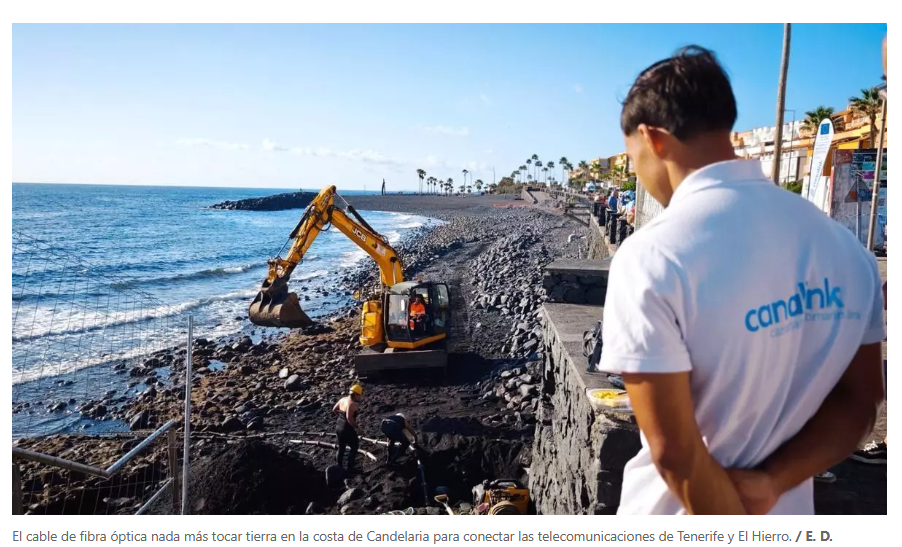
The Italian cable-laying vessel Teliri completed a key stage of the installation on Sunday, 11 October, bringing the cable ashore near Las Caletillas in Candelaria. The new connection is designed to make communications across the western Canary Islands more reliable and reduce the risk of an island being cut off digitally if an existing cable fails.
It’s an important development for something most of us only notice when it stops working.
A delicate operation off Candelaria
The installation took place near Las Caletillas, where the Teliri positioned itself around 200 metres offshore.
Inflatable boats helped transfer the cable towards the shore, while special buoys kept it afloat during the anchoring process to reduce the risk of damage.
This stage completes a key part of the route between El Tamaduste, in Valverde on El Hierro, and Las Caletillas in Candelaria.
Canalink, working under the supervision of the Cabildo de Tenerife and the Institute of Technological and Renewable Energies (ITER), has also prepared the necessary facilities on land, including connections to the technical centre in Güímar.
Further checks and adjustments are still required before the system can enter service, which is planned for later this year.
Why does El Hierro need another cable?
At present, El Hierro depends on a single submarine cable operated by Telefónica, connecting it to La Gomera and indirectly to Tenerife.
That creates a potential weak point. If the existing route suffers a serious fault, the island’s communications could be disrupted.
The new cable will provide an alternative physical route, allowing data traffic to be redirected if one connection fails.
That matters for far more than internet browsing. Telecommunications infrastructure supports phone calls, WhatsApp messages, emails, banking services, card payments, video calls and remote working.
The new connection is intended to improve reliability and provide capacity for growing demand from cloud services and other data-heavy activities.
However, don’t expect everyone to suddenly see a dramatic increase in internet speed. Actual performance will still depend on local networks and the service customers pay for. The main benefit is greater resilience if a cable goes down.
A €19 million investment
The project involves an investment of €19 million, including €13.2 million from the European Union’s Connecting Europe Facility for digital infrastructure.
Work began on 1 January 2024, with completion planned by 31 December 2026.
The cable stretches approximately 240 kilometres and is around five centimetres in diameter. Inside are optical fibres thinner than a human hair, transmitting data using pulses of light.
Several protective layers, including steel, help shield the cable from damage, with the design adapted to the conditions along the seabed.
Around 95% of digital communications in the Canary Islands rely on submarine cables, underlining just how important these connections are to everyday life across the archipelago.
More islands could be connected
The project doesn’t stop with Tenerife and El Hierro.
A second phase is planned to add two underwater branching units, extending the network towards La Palma and La Gomera. The aim is to improve connections between the four islands in the province of Santa Cruz de Tenerife.
Further links between Gran Canaria, Lanzarote and Fuerteventura are also being pursued, with the wider objective of giving the islands alternative routes if an undersea connection fails.
The system won’t prevent every possible communications outage. Power failures, data centre problems and faults in land-based networks can still cause disruption. But adding another submarine route should reduce the risk of a single cable failure isolating an island.
The major blackout in April 2025 was a reminder of how much modern life depends on reliable infrastructure. This project won’t solve every problem, but it should give the western islands another important layer of protection.