
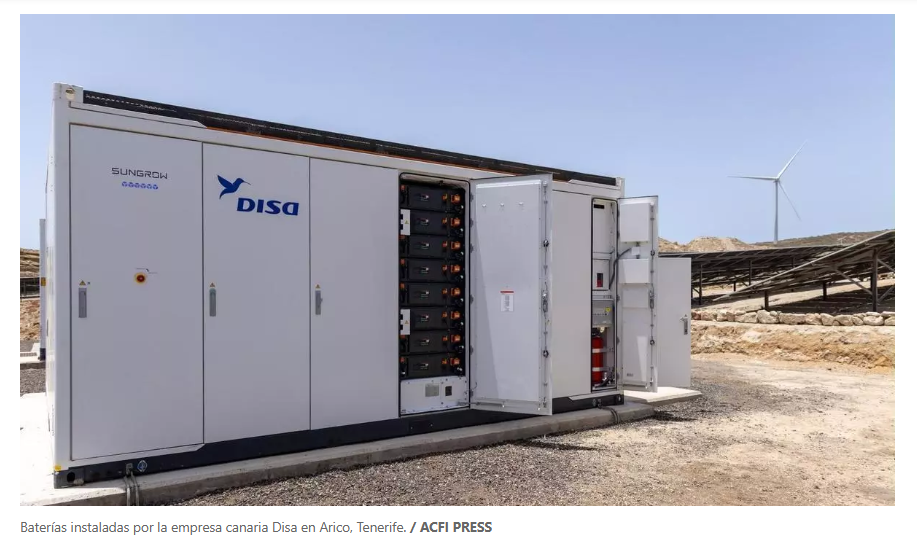
Tenerife wants to make a big change to the way it produces electricity, moving from around 20% renewable energy to almost 80%. And a growing number of giant battery projects could play a major role in making that happen.
Over the past 14 months, 22 private energy storage projects have been launched across the island, representing more than €113 million in proposed investment.
The idea is straightforward. Store surplus electricity generated by solar panels and wind turbines, then feed it back into the grid when demand rises or renewable production drops.
If all the proposed projects are completed, their combined storage capacity could provide enough electricity to meet Tenerife’s needs for around two hours. That’s equivalent to the daily electricity requirements of approximately 75,000 homes.
It’s an important step towards reducing the island’s dependence on imported fossil fuels, although getting these projects off the drawing board and into operation is the next challenge.
Where are the battery projects being built?
Several municipalities are attracting investment, with Los Realejos emerging as an important centre for energy storage.
Projects involving Capella, Polaris and Sirius Batteries account for more than €13 million in declared investment there.
Santa Úrsula is another significant location, with two projects from Merak Storage representing more than €21 million in investment.
Other developments are planned in Arona and Santa Cruz de Tenerife, alongside proposals from companies including EDP Renewables España and Iberdrola Renovables Canarias.
Together, these projects could create a network of large-scale batteries distributed across the island, helping the electricity grid cope with changing levels of renewable generation and demand.
Why Tenerife needs giant batteries
Solar and wind power have one obvious limitation: they don’t produce electricity at a constant rate.
Solar panels generate most of their electricity during daylight hours, while wind production depends on the weather. Without sufficient storage, surplus renewable electricity can go unused, while the grid still needs conventional power stations when production falls short.
Large battery systems can help bridge that gap by storing excess electricity and releasing it when needed.
Ricardo Guerrero, from the University of La Laguna, believes sufficient storage will be essential if Tenerife is to increase renewable energy’s contribution from around 20% to approximately 80%.
Energy storage could also help improve the grid’s resilience during certain disruptions, although batteries alone cannot prevent every blackout.
A changing investment landscape
The Cabildo’s energy adviser, Juanjo Martínez, has also highlighted the importance of storage in making better use of renewable energy.
Changes to the regulatory framework now allow independent storage facilities to purchase electricity at a regulated price, making these projects more attractive to investors.
That has helped encourage interest in a sector that could become increasingly important as Tenerife looks to reduce its reliance on imported fuels.
Of course, announced investment doesn’t automatically mean completed infrastructure. The real test will be how many of these projects receive the necessary approvals, get built and begin supplying electricity to the grid.
Batteries, geothermal energy and hydroelectric power
Battery storage is only one part of Tenerife’s wider energy plans.
The island is also exploring geothermal energy, which uses heat from beneath the Earth’s surface to generate electricity, as well as a proposed reversible hydroelectric plant in Güímar.
These technologies could complement one another. Batteries can respond quickly to changes in electricity demand, while geothermal power could provide a more consistent source of renewable generation. Reversible hydroelectric systems can store energy by pumping water uphill and releasing it through turbines when electricity is needed.
Combining different technologies would give Tenerife more options for balancing its electricity supply and making better use of its natural resources.
Can Tenerife really reach 80% renewable energy?
The ambition is certainly there, and the number of proposed battery projects suggests investors see opportunities in the island’s energy transition.
But reaching almost 80% renewable energy will depend on more than batteries. Tenerife will also need sufficient renewable generation, reliable grid connections and the infrastructure to move electricity around the island when and where it’s needed.
If the projects move ahead as planned, large-scale storage could become a key part of a cleaner and more independent energy system.
For an island that still relies heavily on imported fossil fuels, that’s a change worth watching.