
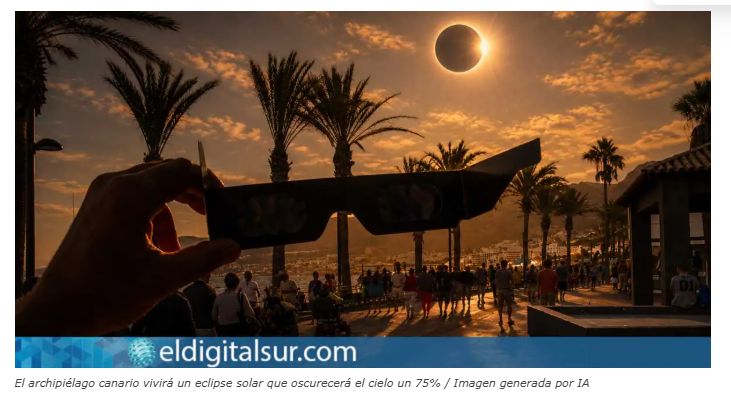
If you’re lucky enough to be in Tenerife on Wednesday 12th August 2026, make sure you look up…well, with the proper eclipse glasses on of course.
Spain is about to witness its first total solar eclipse in well over 100 years. While the mainland gets the full show in many areas, those of us in the Canary Islands will still be treated to something pretty special.
From Tenerife, around 75% of the Sun will be covered by the Moon just before sunset, making for a very unusual evening.
What time does the eclipse happen in Tenerife?
For anyone in Santa Cruz de Tenerife, the eclipse begins at 6:58pm.
It reaches its maximum at 7:53pm, when around 75% of the Sun will be obscured. At that point, the Sun will already be sitting quite low in the western sky, making for some fantastic viewing if the weather behaves itself.
The eclipse finishes at 8:45pm.
Over in Las Palmas, the timings are almost identical, with the maximum taking place at 7:54pm and the eclipse ending just after sunset at 8:43pm.
What about the rest of Spain?
This is where things get really interesting.
Large parts of northern Spain will experience a total solar eclipse, something the country hasn’t seen for generations. Cities including A Coruña, Oviedo, León, Bilbao, Zaragoza, Valencia and Palma all fall close to the path of totality.
Because Spain sits right at the end of the eclipse’s path, the Sun will already be very low on the horizon when totality arrives. That means anyone hoping to see the full event on the mainland will need an uninterrupted view looking west.
The good news is that August usually brings plenty of clear skies across much of Spain, so fingers crossed.
A rare run of eclipses
What’s even more remarkable is that this won’t be a one-off.
Spain is entering a very unusual period for astronomy. After this eclipse in August 2026, another total solar eclipse arrives on 2nd August 2027, followed by an annular eclipse on 26th January 2028.
After that, there won’t be another total solar eclipse visible from Spain until 2053.
So if you’ve ever fancied seeing one, the next couple of years are about as good as it gets.
Don’t forget your eye protection
One thing that’s worth mentioning…don’t be tempted to look directly at the Sun.
Regular sunglasses won’t do the job.
If you’re planning to watch the eclipse, make sure you use certified solar viewing glasses or another approved viewing method. Looking directly at the Sun without proper protection can cause permanent eye damage, and it’s simply not worth the risk.
The Spanish National Geographic Institute has also published maps, viewing times and official guidance if you’d like to plan exactly where you’ll be when it happens.
It should be quite a sight, especially with the eclipse taking place as the Sun sets over the Atlantic. If the skies stay clear, it could be one of those evenings that people remember for years.