History has a habit of revealing new stories when you least expect it.
Most people driving through Tijoco, in the hills above Adeje, probably see a quiet village with an old chapel and little reason to think much about its past. But new research has uncovered a remarkable chapter of Tenerife’s history that dates back more than 500 years.
It tells the story of two families who fled the Spanish Inquisition and eventually made Tijoco their home.
Escaping the Inquisition
The research, carried out by José Antonio González Marrero from the University of La Laguna and researcher Carmen Rosa Escobar Suárez, traces the family history of Antonio de Castro and Leonor Sánchez Falcón.
Although they became respected landowners in Tenerife, both families descended from Jewish converts to Christianity, known as conversos, who left mainland Spain during the early 16th century to escape persecution by the Holy Office.
Like many others at the time, they were forced to hide their origins while trying to build a new life.
Tijoco became their legacy
Historical documents reveal that Antonio de Castro owned a large estate in what is now Tijoco, complete with farmland, water rights and a sugar mill.
His will, written in 1572, refers to the estate as La Concepción de Nuestra Señora, linking the property directly with the area that still exists today.
After his death, ownership passed through his family, ensuring that the estate remained an important part of the local community for many years.
Researchers believe the original sugar mill and chapel were built before 1520, making them among the oldest surviving examples in the south of Tenerife.
A carefully hidden past
The research also uncovers the lengths these families went to in order to protect themselves.
Records preserved by the Canary Islands’ Inquisition show that members of the Castro family were questioned about their ancestry and forced to declare their family history before the authorities.
Some relatives had already been prosecuted for practising Judaism, while others publicly declared themselves faithful Catholics in an effort to avoid further suspicion.
The study suggests many converso families married within their own community and carefully coordinated what they told the Inquisition, helping to protect one another during an extremely dangerous period.
A different way of looking at Tijoco
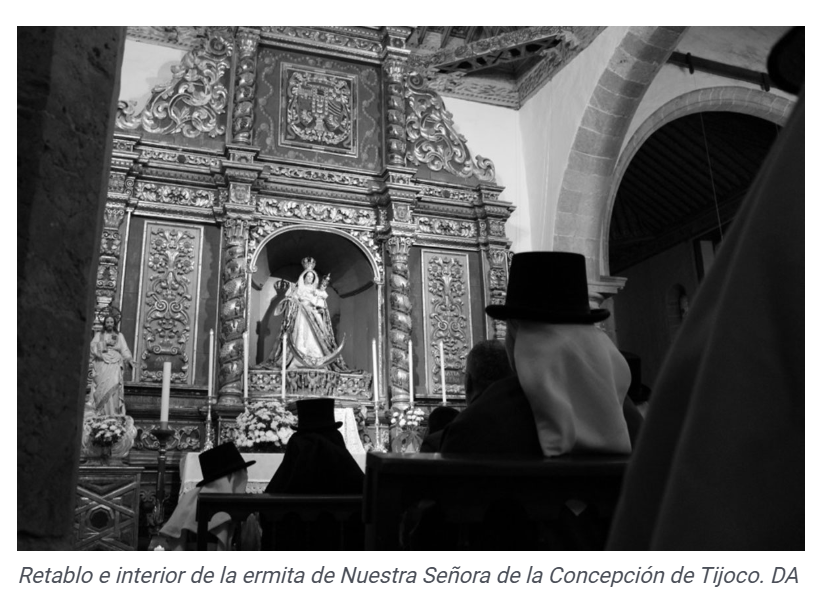
Today, the Ermita de Nuestra Señora de la Concepción still stands quietly overlooking the surrounding countryside.
For years it has been seen simply as one of the historic landmarks of southern Tenerife.
Thanks to this new research, it can now also be viewed as a symbol of resilience, representing the place where families fleeing persecution finally found somewhere they could put down roots and begin again.
It’s a fascinating reminder that beneath the surface of Tenerife’s towns and villages are stories that have remained hidden for centuries, waiting for someone to uncover them.