
“A grade doesn’t define you.”
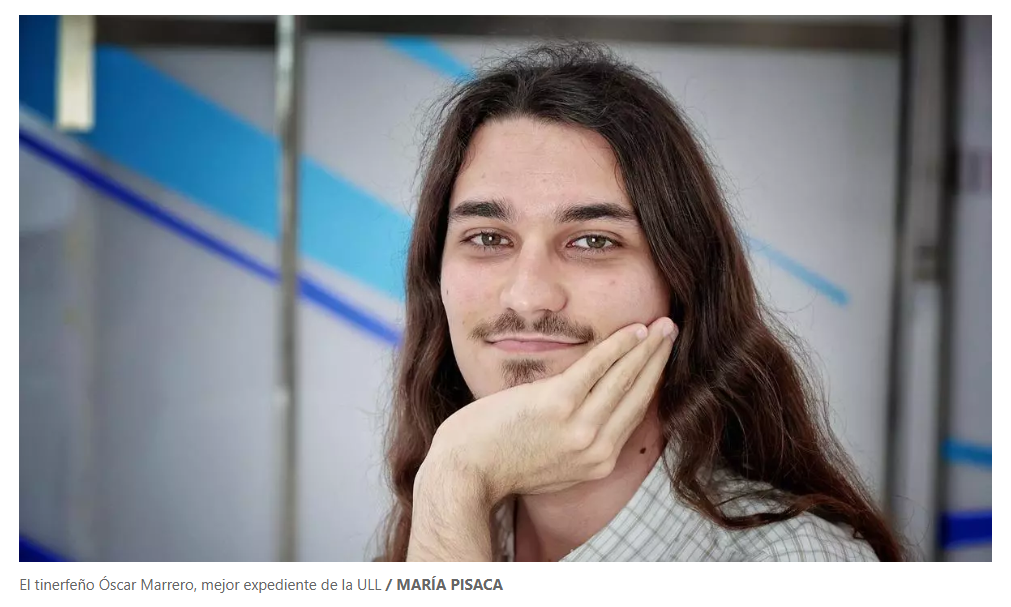
It’s a message that carries extra weight coming from Óscar Marrero, the Tenerife student who graduated with the highest academic record at the University of La Laguna (ULL) in the 2024/2025 academic year.
The Philosophy graduate finished his degree with an impressive 9.7 average, earning not only the best results in his class, but the highest overall academic record across the entire university.
What makes his achievement even more remarkable is that he doesn’t attribute it to endless hours of studying or an obsession with grades.
Instead, he believes the key has always been something much simpler.
“Curiosity Is the Most Important Thing”
For Marrero, academic success begins with a genuine desire to understand the world.
“If I had to choose one thing, I’d say curiosity is the most important,” he explains.
The former student of IES Agustín de Betancourt in Puerto de la Cruz admits he was far from being a standout pupil during his years in compulsory secondary education.
“I wasn’t the type of student who was constantly worried about getting top marks,” he says.
Things changed during Bachillerato. Motivated by university entrance exams and an increasing interest in learning, he achieved a perfect academic record, finishing with a grade of ten in every subject across the two-year programme.
From Psychology to Philosophy
Initially, Marrero was drawn towards the sciences.
His interest in psychology led him to study subjects linked to health sciences, while his fascination with areas such as neuroscience encouraged him to explore biology independently.
However, the more he read, the more he discovered that many of the questions that interested him most had philosophical roots.
“I realised I was more interested in the fundamental questions than working in a laboratory,” he says.
That realisation led him to enrol in a Philosophy degree at the University of La Laguna.
Exploring the Biggest Questions
During his time at university, Marrero developed a particular interest in logic, philosophy of mind, language and consciousness.
His final-year dissertation tackled one of philosophy’s most debated topics: the nature of consciousness itself.
The project examined panpsychism, a theory suggesting that some form of consciousness may exist throughout all matter, even in objects we normally consider inanimate.
“It seemed like a completely crazy idea to me,” he says with a smile.
Yet it was precisely those kinds of challenging questions that kept him engaged throughout his studies.
The Surprise Recognition
Although he knew he had achieved the highest marks in his Philosophy cohort, Marrero had no idea he had also earned the best academic record in the entire university.
The news arrived unexpectedly through an email from the University of La Laguna inviting him to a recognition ceremony.
“I didn’t even know those awards existed,” he admits.
The recognition came as a surprise partly because he never felt he had made extraordinary sacrifices.
In fact, he insists he has never been an especially prolific reader.
“I always tell people that studying Philosophy requires a reading habit, but not necessarily a love of reading. I simply learned to choose the right texts and focus on understanding them.”
The Philosophy Graduate Who Finished Feeling He Knew Nothing
Like many university graduates, Marrero left his degree with a curious feeling.
Despite achieving almost perfect grades, he felt there was still so much left to learn.
“You finish and realise how much you don’t know,” he explains.
With countless branches of philosophy and only a limited amount of time to study each one, he believes curiosity is what ultimately makes the difference.
Those who continue exploring beyond the classroom often gain the most from their education.
A Future in Teaching
Now studying for a Master’s degree in Education, Marrero hopes to become one of those teachers who leave a lasting impact on their students.
“I feel very comfortable in the classroom,” he says. “During my teaching placements I’ve seen that students really enjoy my lessons.”
He is particularly passionate about showing young people that philosophy isn’t an abstract subject disconnected from everyday life.
Topics such as ethics, politics, identity, death and even questions about whether we live in a simulation can all become meaningful discussions in the classroom.
For many teenagers, he believes, philosophy provides a space to explore the same questions they already discuss with their friends.
His Advice for Future University Students
Despite holding the best academic record at the University of La Laguna, Marrero’s advice to future students is refreshingly down to earth.
He warns against becoming obsessed with perfection.
“People often spend far more time studying than they need because they want to know absolutely everything,” he says.
Instead, he believes understanding the main concepts and learning how to connect ideas is often more valuable than memorising every detail.
Most importantly, he wants students to remember that grades are only one part of the picture.
“A mark doesn’t define who you are,” he says.
“If things don’t go well, there will always be another opportunity, another exam or another path forward.”
For someone who has just been named the top graduate at one of the Canary Islands’ leading universities, it’s a lesson that may be just as valuable as any qualification.