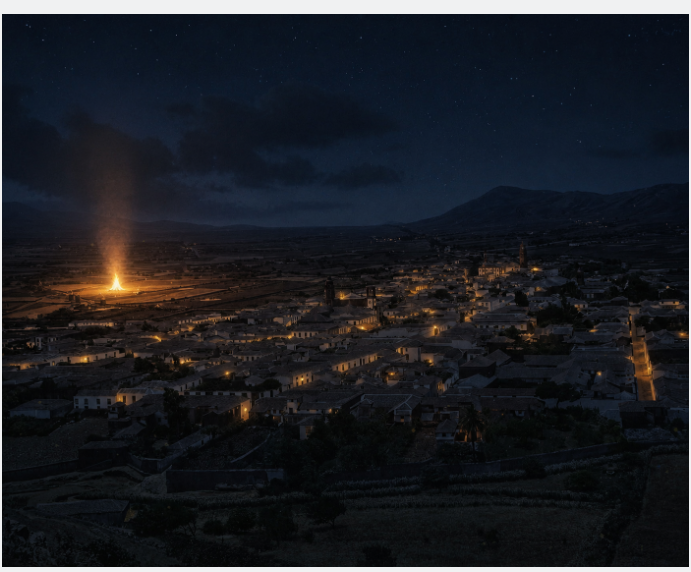
Tonight, beaches, towns and villages across Tenerife will be illuminated by bonfires as people gather to celebrate the Night of San Juan, one of the most symbolic and magical dates in the calendar.
Although many associate the celebration with Saint John the Baptist, its origins go back much further. The ancient Celts knew this festival as Alban Heruin, a celebration linked to the summer solstice, when the sun reaches its greatest strength and daylight lasts longer than at any other time of the year.
For centuries, communities marked this moment by lighting large fires to attract good fortune, protect their homes and crops, and welcome the abundance of summer.
Fire at the Heart of the Celebration
There are countless rituals associated with the Night of San Juan, celebrated on the eve of 24 June, but almost all of them revolve around one powerful element: fire.
Bonfires are lit across Spain and the Canary Islands as symbols of purification, renewal and protection. According to tradition, jumping over the flames helps leave behind bad luck and brings good fortune for the year ahead.
The number of jumps varies depending on the region.
In Galicia, tradition calls for nine jumps. In Alicante and Valencia, the magical number is seven. Here in the Canary Islands, however, three is considered the lucky number, both for jumping over the bonfire and for taking part in another important ritual connected to the sea.
The Power of Water
Water plays an equally important role in the San Juan celebrations.
One of the most popular traditions is bathing in the sea during the night or in the early hours of 24 June. Many believe this ritual brings health, protection and positive energy for the coming year.
According to local custom, jumping over the first three waves with your back to the sea helps wash away negativity and attract good fortune. Some traditions also associate the ritual with fertility and renewal.
Elsewhere in Spain, different customs have developed over the centuries. In parts of Andalusia, people wash their faces at midnight in the belief that it will help preserve health and beauty throughout the year. Tradition also warns against looking in a mirror afterwards if the ritual is to work properly.
A Celebration Rooted in the Solstice
While the Night of San Juan is celebrated on the eve of 24 June, its origins are closely linked to the summer solstice, which falls on 21 June.
Over time, the Church incorporated many of these ancient solstice traditions into the feast of Saint John the Baptist, allowing customs linked to fire, water and renewal to survive through the centuries.
Today, San Juan remains one of the most eagerly anticipated nights of the year across Tenerife. Whether it’s for the bonfires, the midnight swim, the traditions passed down through generations or simply the atmosphere of a warm summer evening by the sea, it continues to bring people together in a celebration that feels every bit as magical as it did hundreds of years ago.