
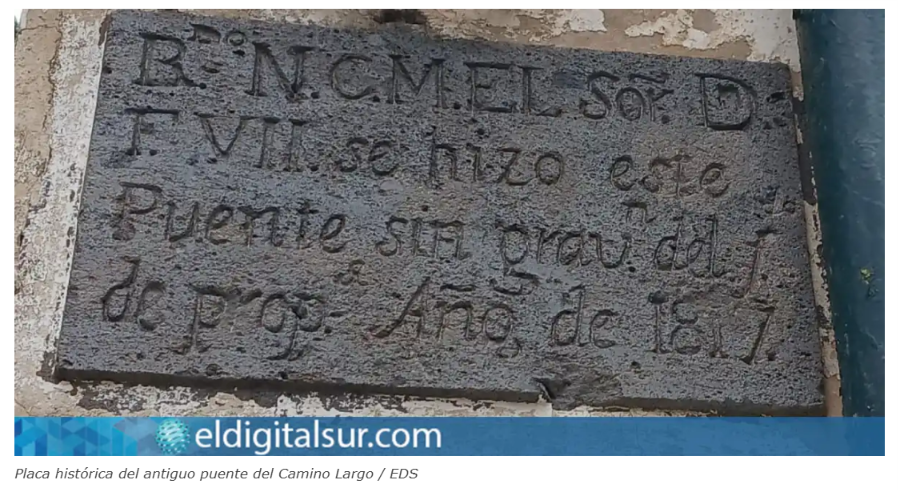
The stone plaque on Camino Largo has had a bit of attention, with La Laguna Council completing restoration work on a marker that dates back to 1817.
The plaque commemorates the rebuilding of the old wooden bridge, which had been there since the 16th century. It was reconstructed in stone during the reign of Fernando VII, making it easier for people to cross the stream carrying water from the slopes of Las Gavias towards the old lagoon.
It might not look like much today, but the bridge played an important part in the city’s historic road network, linking La Laguna with the agricultural land around it.
The restoration involved cleaning and stabilising the stone, removing surface dirt, built-up debris and vegetation. Given its historical importance, the work was carried out by a professional specialist in heritage restoration.
The inscription itself records that the bridge was built in 1817, without drawing on the town’s public funds. It’s also included in a 2022 guide to the inscriptions, coats of arms and busts found in La Laguna’s historic centre, compiled by historian Miguel Ángel Gómez Gómez.
Councillor for Cultural Heritage Adolfo Cordobés says the plaque helps explain how the city developed and how its residents once lived with a landscape shaped by water.
Camino Largo is one of La Laguna’s best-known historic routes. Its official street name is Paseo de la Universidad, following a council decision in 1908, although most people still know it by its traditional name.
The route connects the town centre with the agricultural area of La Vega, following what was once the south-eastern edge of the old lagoon that gave La Laguna its name.
Part of a wider restoration programme
The plaque is one of the projects included in the third phase of the council’s programme to restore sculptures, busts and monuments in public spaces.
Around a dozen other pieces are also due to receive conservation work across the municipality. They include the Virgen del Carmen at Cruz del Carmen, the statue of Zebenzuí in Punta del Hidalgo, several commemorative busts, the Tinguaro monument and works by local artist Paco Palomino.
It’s good to see some attention being given to these smaller pieces of history. They might not attract the crowds, but they help tell the story of how La Laguna became the place it is today.