
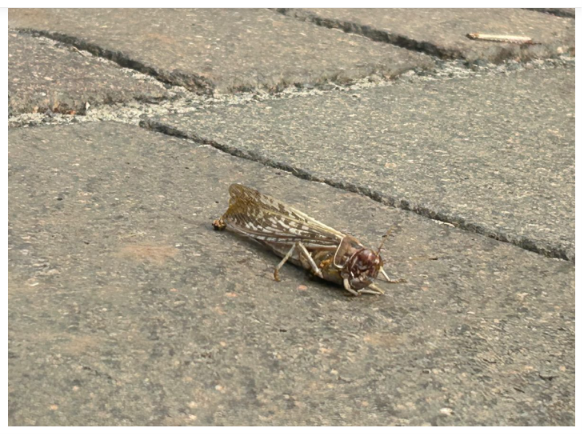
A locust photographed on a pavement in Santa Cruz on Thursday, 5 November, has got people wondering how it ended up in the island’s capital.
The insect appears to have the characteristics of a migratory locust, possibly even the desert locust (Schistocerca gregaria). But there’s no confirmed identification yet, and it would be wrong to jump to conclusions based on a photograph alone.
One possibility being discussed is that it arrived from Africa, carried across by winds from the east or south. These air currents can transport insects towards the Canary Islands, particularly during episodes of Saharan dust.
Could it have travelled from Africa?
The State Meteorological Agency (Aemet) has previously recorded desert locusts reaching the Canaries on African winds. The same weather patterns can also bring calima to the islands.
The Food and Agriculture Organisation (FAO) says desert locusts can travel up to 150 kilometres in a day by making use of air currents. Given the proximity of the Canaries to the African coast, it’s certainly a possibility.
However, there’s another explanation worth considering.
The Museum of Nature and Archaeology in Tenerife has pointed out that the African migratory locust is already present across all the Canary Islands. It can be found in small, solitary numbers, particularly in dry areas.
In other words, the insect photographed in Santa Cruz might not have arrived recently at all. It could simply have been living on the island for some time.
The weather doesn’t tell the whole story
Aemet’s forecast for Thursday predicted cloudy intervals, possible scattered showers, light south-westerly winds and coastal breezes.
Those conditions aren’t typically associated with locusts being carried across from the Sahara. That doesn’t rule out an earlier arrival during a different weather episode, or the possibility that the insect was already here.
There is some recent history, too. In February 2026, locusts were reported in several parts of Tenerife during an episode of calima, with reports linking their arrival to favourable wind conditions.
Should anyone be worried?
Not particularly, based on one insect.
A solitary desert locust behaves very differently from the large swarms that can cause serious agricultural damage. Swarming behaviour develops when populations become sufficiently dense and environmental conditions allow numbers to increase.
The Canary Islands have experienced major locust invasions from Africa in the past, including notable events in 1954 and 1958. But those large-scale movements are a very different matter from finding a single insect on a pavement in Santa Cruz.
At present, there is no evidence of a wider locust presence in the city linked to this sighting.
The exact species and origin of the photographed insect remain unconfirmed. Until an expert examination provides a clearer answer, the most sensible approach is to treat it as an interesting sighting rather than the start of an agricultural emergency.