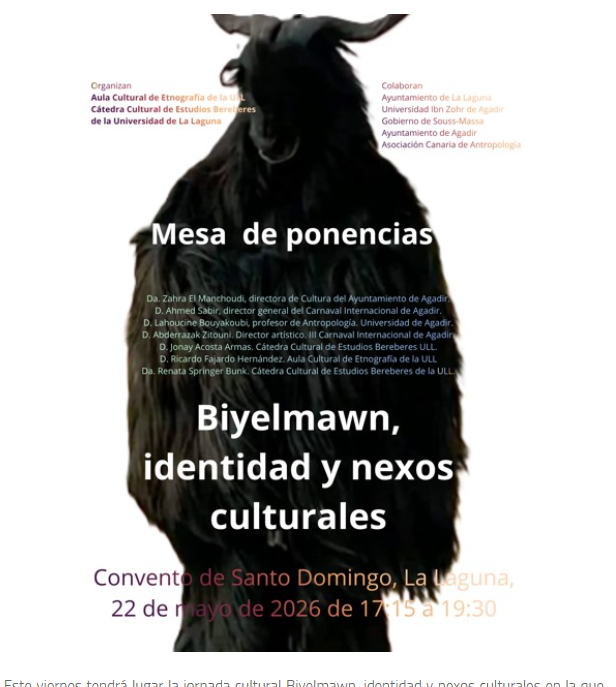
La Laguna will host an interesting cultural event this Friday looking at identity, tradition and the historical links between the Canary Islands and Morocco.
“Biyelmawn, Identity and Cultural Connections” takes place at the Convent of Santo Domingo from 17:15, bringing together researchers, academics and cultural representatives from both regions.
Not your average Friday evening event admittedly… but an interesting one if local history and heritage are your thing.
Delegation from Morocco and La Laguna University
The event welcomes representatives from Souss-Massa, southern Morocco, connected with Ibn Zohr University, alongside researchers from:
• Cultural Classroom of Ethnography – ULL
• Cultural Chair of Berber Studies – ULL
The session will be introduced by Ahmed Sabir, presenting the Biyelmawn Carnival Committee of Agadir, whose celebrations run from 15 to 22 June.
Talks Exploring Culture and Identity
Speakers from Morocco include:
• Zahra El Machoudi – Cultural Officer, Agadir City Council
• Lahoucine Bouyakoubi – Anthropology Professor, Ibn Zohr University
• Abderrazak Zitouni – Artistic Director of the International Carnival of Agadir
Topics will include the cultural and ritual importance of Biyelmawn within Amazigh traditions.
Canary Islands Research Presentations
The second part of the event focuses on Canary heritage with presentations from:
• Jonay Acosta Armas – Ancient place names of El Hierro
• Renata Springer Bunk – Use of Tifinagh writing among the Tuareg
The evening finishes with an open discussion.
Folklore Continues on Saturday
The cultural exchange continues on Saturday at 19:30 at the Casa de la Cultura de La Esperanza with a folklore showcase featuring Canarian and Moroccan groups.
The Folkloric Group of the Faculty of Education, directed by Manuel Lorenzo Perera, will also perform.
Interesting really how many links still keep appearing between the Canaries and North Africa once you start digging into history.