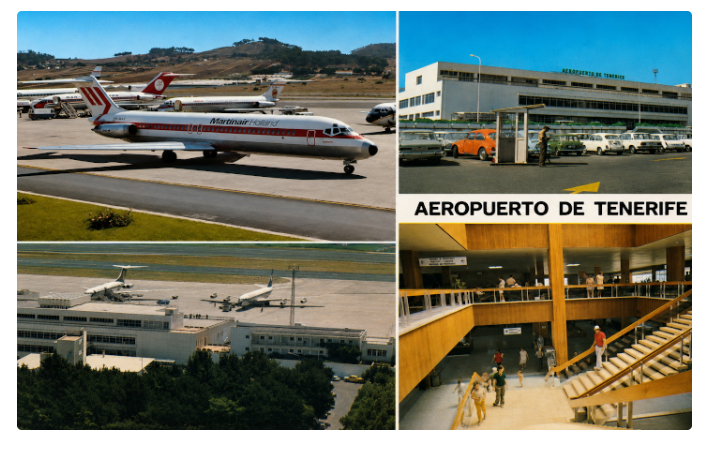
The development of Tenerife North Airport was closely linked to the tourism boom that reshaped Bajamar during the 1960s and 1970s
It’s easy to look at Bajamar today and forget how different this part of Tenerife once was.
For generations, the area was largely shaped by agriculture and fishing. Then tourism arrived, investment followed, and the coastline began to change at a remarkable pace.
One of the key pieces of that story was Los Rodeos Airport.
From dirt runway to international gateway
The story began in the late 1920s, when German airline Lufthansa requested an air connection between Berlin and Tenerife via Seville.
The Cabildo prepared land on a plateau in the municipality of San Cristóbal de La Laguna, more than 600 metres above sea level.
The first aircraft landed at Los Rodeos in 1929, arriving from Seville on what was still little more than a dirt airstrip.
The airport’s importance grew quickly. It was declared a national airport in 1930, while its first terminal was built in 1943.
On 3 May 1946, a ministerial order officially opened the airport as a customs airport for national and international traffic.
That connection to the outside world would become increasingly important as Tenerife’s tourism industry began to take off.
The tourism boom arrives
The 1960s marked a major turning point.
The runway was extended and the airport became increasingly important as visitor numbers grew. Although its official name changed to Tenerife Airport, locals continued to call it Los Rodeos.
At the same time, international investment began flowing into Tenerife.
German investors were particularly prominent, encouraged by tax incentives for overseas investment. Investors from Sweden, the Netherlands and Britain, along with Spanish entrepreneurs, also became involved.
Coastal land that had previously had limited commercial value suddenly looked rather different.
And Bajamar was right in the middle of it.
Bajamar begins to change
During the 1960s, previously undeveloped parts of the coastline began to be urbanised.
Hotels, shops and other tourist facilities appeared, while the area became increasingly attractive to people looking for holiday homes.
Families from La Laguna began buying properties in Bajamar, while entrepreneurs saw an opportunity in rising coastal land values.
It was a dramatic change from the traditional way of life.
The airport was bringing increasing numbers of visitors to Tenerife, while investors were looking for somewhere to put them.
Bajamar provided the space.
From fishing village to tourist destination
The transformation wasn’t simply economic.
For generations, local life had revolved around fishing and agriculture. Within a relatively short period, tourism and property development became major forces shaping the area.
This period is now generally remembered as the tourist boom, when tourism in the Canary Islands moved from being a relatively small part of the economy to becoming a major industry.
Bajamar became one of the places where that transformation was particularly visible.
The coastline changed, new accommodation was built and the traditional landscape was gradually replaced by a more developed tourist environment.
Airport, tourism and property
The connection between Los Rodeos, tourism and property investment is difficult to separate.
Better air connections brought more visitors. More visitors created demand for accommodation. That demand attracted investors, which led to new construction and rising land values.
And places such as Bajamar were transformed in the process.
By the 1960s and 1970s, the area had moved a long way from the small coastal community it had once been.
The legacy of that period is still visible today.
Some of Bajamar’s character comes from what was there before the tourism boom. Much of the built environment, however, reflects the decades when Tenerife opened itself up to mass tourism and international investment.
It’s a useful reminder that Tenerife’s tourism story wasn’t just about the big resorts in the south. Los Rodeos and places such as Bajamar were also part of the much bigger transformation that changed the island’s economy, coastline and way of life.