
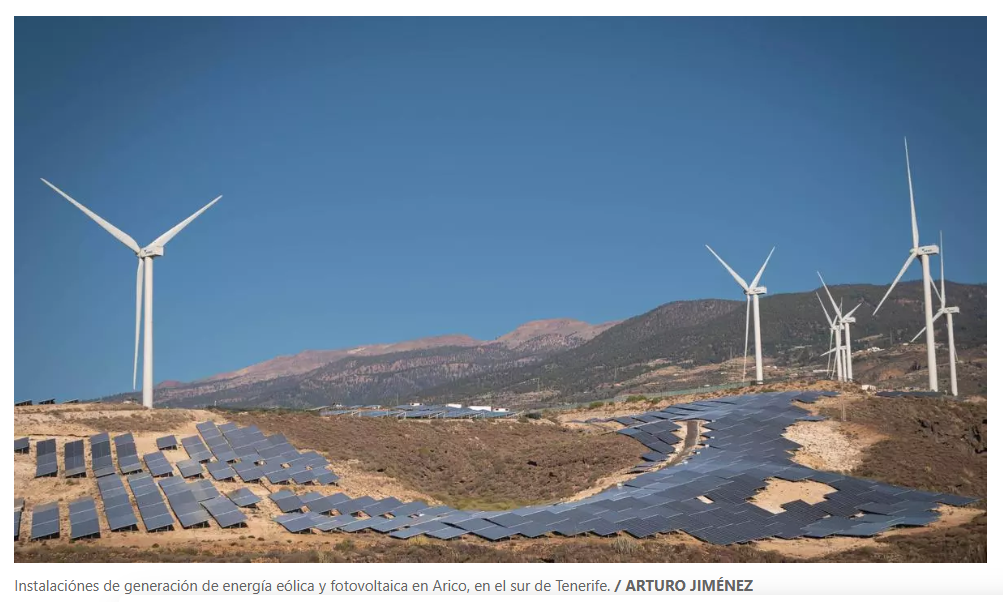
The nearly five-hectare project will generate almost 5 MW of power, but its grid connection has raised questions over protected land and the future use of the area
A new large-scale solar project is moving ahead in Arona, although not without some fairly significant concerns about the environmental and agricultural impact.
The Canary Islands Government has approved the Llano de los Bebederos I photovoltaic plant, promoted by Disa, which will occupy almost five hectares and have a generating capacity of close to 5 MW.
The project has a budget of more than €259,000.
It will involve installing 8,610 ground-mounted, dual-sided photovoltaic panels, each rated at 700 watts.
The problem is getting the electricity out
The main disagreement isn’t so much about the solar panels themselves as what happens afterwards.
The electricity will need to be transported to the grid via a medium-voltage evacuation line, with the proposed route passing through areas that are classified for environmental protection.
The Tenerife Insular Planning Authority has raised concerns about the route and suggested alternative options, along with a more detailed environmental assessment.
The route also passes through an area around the Llano Azul ravine that contains native vegetation including tabaibal dulce and baleras.
Environmental conditions attached to the project require additional protection for sensitive areas during construction.
Agricultural land also a concern
The Tenerife Cabildo and Arona Town Hall have both expressed reservations about the use of the land.
Part of the argument is that the area could potentially be used for agriculture and has been considered for a future Agricultural Strategic Reserve.
Disa, however, argues that the land has been unused for more than 30 years and has no irrigation infrastructure, making it unsuitable for agricultural production and more appropriate for renewable energy.
The Cabildo has warned that the growing number of photovoltaic projects could gradually reduce the amount of land available for agriculture.
The project has been declared of general interest
Despite those concerns, the project has been given a route forward.
The Canary Islands Government declared the solar plant of general interest in January 2025, followed by Decree 101/2026, which allows the project to proceed and makes the necessary planning changes to facilitate renewable energy generation.
Disa does not currently own all of the land required for the evacuation line.
The declaration allows for forced expropriation if agreements cannot be reached with landowners. The project has a five-year deadline for completion, which can be extended to eight years.
Plenty of conditions before construction
Approval doesn’t mean the bulldozers can simply turn up tomorrow.
The project remains subject to a series of environmental, heritage and technical requirements.
These include an archaeological survey to ensure that no significant remains are affected, as well as specific compliance measures relating to solar and wind installations.
There will also be environmental monitoring for the alcaraván común, a sensitive native bird found close to the proposed installation.
Measures will include effective fencing and limiting light pollution to reduce the potential impact on wildlife.
Public health authorities have also recommended controlling dust, noise and vibrations during construction, while electromagnetic fields around the evacuation line will need to be monitored.
So, while Arona is getting another renewable energy project, it isn’t quite as simple as covering five hectares in solar panels and plugging it into the grid.
There are protected habitats, agricultural land, wildlife and existing landowners to consider before the first panel goes in.