
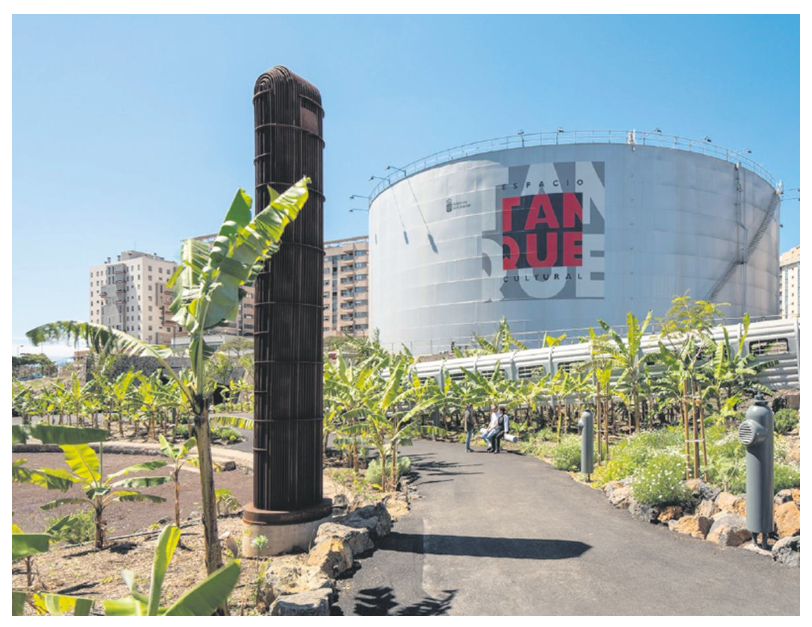
There aren’t many cultural venues in Tenerife that can claim to have once stored millions of litres of fuel. Then again, Santa Cruz has never been short of interesting ways to reuse its industrial past.
The Espacio Cultural El Tanque, in Cabo-Llanos, began life as tank number 69 at the Santa Cruz oil refinery. One of around 100 storage tanks, it had a capacity of 39 million litres and was used to store fuel destined for ships.
It fell out of use in 1958, around the same time that the city’s urban development plans turned Cabo-Llanos into a residential area.
Rather than simply demolishing the old structure, architect Fernando Martín Menis suggested that the Cabildo should preserve it and turn it into a cultural venue. The tank was the only remaining reminder of the area’s industrial history, and its size offered plenty of possibilities.
A surprisingly sensible idea, as it turned out.
Saving El Tanque from demolition
In December 1995, the Cabildo signed an agreement with Cepsa, paying 16 million pesetas for the work needed to clear and prepare the tank.
The Espacio Cultural El Tanque officially opened on 17 July 1997, although the arrangement was initially intended to be temporary.
That became a problem the following year, when Cepsa requested the return of the site and the possibility of demolition emerged.
The response was immediate. A group called the Association of Friends of the Espacio Cultural El Tanque was formed, bringing together architects, historians, artists, musicians, actors and journalists.
They argued that the building was important not only for its industrial history, but also for its cultural, artistic, archaeological, technological and social value.
The campaign helped secure the future of the tank. The Cabildo eventually bought the plot from Ferrovial Inmobiliaria, although the decision attracted criticism from more conservative sectors of Tenerife society, who believed it conflicted with Santa Cruz’s urban development plans.
Several planning and land agreements followed, involving Cepsa-Disa, Gestur, Santa Cruz Town Hall and the Port Authority, allowing the wider Cabo-Llanos redevelopment to move forward.
Turning a fuel tank into a cultural venue
The circular tank measures 50 metres in diameter and stands 20 metres high. To adapt it for cultural use, the architectural practice AMP, formed by Artengo, Menis and Pastrana, made use of the existing structure and recycled materials recovered from the refinery, which was being dismantled at the time.
Inside, the 50 metal pillars supporting the roof were retained. They are made from metal profiles joined by horizontal braces and arranged in successive circular rings.
The lighting towers are made from old metal drums, transformed into improvised skylights. Natural light enters through small openings in the upper roof, giving the interior a distinctive atmosphere.
Ventilation is also handled naturally. Air moves between the openings in the roof and a series of covered tubes around the lower perimeter, creating convection currents as warm air rises.
No complicated smart-building system required. Just a few holes and a basic understanding of how hot air behaves.
A semi-buried entrance building was added to the platform, housing the information point and public toilets. From there, a narrow ramp leads down into the tank, passing through a five-metre-wide pivoting steel door.
To overcome the difference in levels between the venue and the neighbouring street, the project reused a former passenger walkway, or finger, which had once connected the roof of the Maritime Station with Trasmediterránea’s ferry.
A space built for all sorts of performances
The architectural conversion created a venue with distinctive acoustic, spatial and sensory qualities.
Its flexible lighting and stage arrangements allow it to host a wide range of events, including concerts, audiovisual productions, dance performances, multimedia installations and exhibitions.
The building’s heritage value comes from several elements: its industrial and technological history, its unusual design, its representative role as a storage tank and the originality of adapting an industrial structure for cultural use.
It is a good example of how an old building does not always need to be knocked down and replaced with something shiny and expensive. Sometimes the bones are worth keeping.
A greener setting around El Tanque
In 2021, the Directorate General of Cultural Heritage of the Canary Islands Government commissioned Fernando Menis to rehabilitate the area surrounding El Tanque, following a request from the Association of Friends of the Espacio Cultural El Tanque.
The work created a landscaped square with around 200 banana plants from the Musa paradisiaca family.
The plants can reach around seven metres in height and flower during the summer, helping recreate the agricultural landscape that once covered the farms along the southern coast before the refinery was installed in 1930.
The result gives the industrial structure a much softer setting, combining the remains of Tenerife’s oil industry with a reminder of the agricultural land that came before it.
Awards and international recognition
El Tanque has received recognition from the architectural and cultural sectors over the years.
Among its awards and appearances are:
- 1996: Regional Manuel Oraá y Arocha Architecture Award, presented by the Canary Islands Architects’ Association.
- 1998: Selected as one of 15 works from Spain and Portugal for the Iberfad Architecture Award in Barcelona.
- 1998 and 1999: Participated in the ARCO International Contemporary Art Fair in Madrid as an example of industrial conversion for cultural use.
- 1999: First prize in the LAUS’99 Municipal Communication Design Awards, organised by Foment de les Arts i del Disseny in Barcelona.
- 1999: Recognition at the fifth Architecture Biennial, organised by the Ministry of Public Works and the Higher Council of Architects of Spain.
El Tanque has also appeared on the covers of architectural, historical and cultural magazines, helping draw attention to a building that could quite easily have disappeared altogether.
Today, it remains one of Santa Cruz’s more unusual cultural spaces. A former fuel tank, saved from demolition and given a second life as a venue for art, music and performance.
Not a bad result for something that was once destined to hold enough fuel to keep a few ships moving.