There’s something rather satisfying about growing your own food. Especially when that first courgette finally appears after weeks of watering, waiting and wondering whether you’ve done something terribly wrong.
For Janos Hubert, one of the residents with a plot at the El Durazno community garden in Puerto de la Cruz, that first harvest was a bit of an event.
He took his courgette home and cooked a special Hungarian dish with dill and onion. As he explained, buying the same ingredients in a supermarket would have been cheaper and involved considerably less effort, but it simply wouldn’t have felt the same.
Janos has plot number 17. Alongside more familiar crops, he’s experimenting with Hungarian courgettes and cabbages, using seeds brought over from home. Not everything has worked, but he’s learning as he goes, helped by the internet and, perhaps more importantly, the friendly atmosphere among the other gardeners.
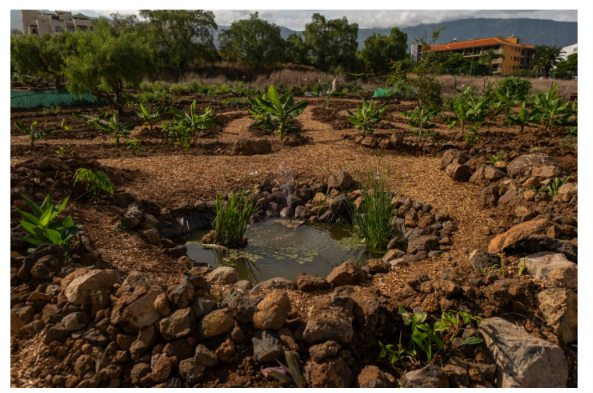
El Durazno is the first urban garden of its kind in Puerto de la Cruz. The project has brought 19,000 square metres of former agricultural land back into use, but the real achievement goes well beyond growing vegetables.
There are 30 individual plots, each measuring around 30 square metres, along with shared areas that the gardeners have helped create and maintain.
These include an avenue lined with banana trees, a small woodland area with fruit trees donated by local residents, native plants, flowers that attract monarch butterflies, composting areas and even a pond. There’s also a rather unusual climbing plant that produces what look like cucumbers but are actually used as bath sponges.
The gardeners organise themselves as they go along. There isn’t a rigid timetable or a complicated set of rules. If someone turns up to water their own plot and notices the shared areas need attention, they simply get on with it. The same goes for clearing weeds and general maintenance.
And there’s plenty growing. Basil, parsley, thyme and rosemary sit alongside tomatoes, lettuce, beetroot, leeks, spring onions, courgettes, aubergines and chard. Melons are also doing well, with their runners spreading along the ground rather than getting in anyone else’s way.
For Margalida Figueroa, president of the El Botánico Residents’ Association and another plot holder, the whole experience has been a learning curve. She admits she knew very little about gardening when she signed up, but says the soil has been generous and she’s gradually getting results.
It wasn’t quite as simple as putting a few seeds in the ground, though.
The site needed a fair amount of work before anyone could start planting. The land was full of rubble and overgrown with weeds, some reaching almost a metre and a half high.
A flock of sheep and goats was brought in to clear the vegetation, although they didn’t quite deliver the results expected. In the end, machinery had to do the job. Margalida jokes that they weren’t entirely satisfied with the sheep’s performance.
Once the ground had been cleared and turned over, compost made from cow manure was added to improve the soil. Raised beds were also created for people with reduced mobility, alongside smaller accessible plots for individuals and organisations.
Making the garden accessible to everyone
The project has made a particular effort to involve older residents and organisations working for social inclusion.
One of those is Visión Azul Autismo. During a visit to the garden, representative Asunción González showed off the group’s plot, which is looked after by children, young people and their families. They choose crops they know are likely to grow successfully, which is probably a sensible approach when you’re starting out.
The garden is managed and brought to life with the support of the La Vereda association, following an initial training period that helped participants learn how to prepare the land and get it ready for cultivation.
There are still a few practical details to sort out, including permanent irrigation and how long each person will be allowed to keep their plot. Some of the current gardeners believe the minimum should be five years, given the amount of work that went into restoring the land in the first place.
That decision will form part of the future regulations, which are also expected to provide a framework for other community gardens around the municipality.
More gardens are on the way
El Durazno won’t be the last.
Councillor David Hernández says the second community garden is expected to open shortly at Jardines Quintana. It will have ten plots, all designed to be accessible and particularly suitable for people with reduced mobility.
There is already considerable demand. Around 80 people have been on the reserve list since the first project got under way, and the council plans to put a third garden out to tender in another neighbourhood.
Hernández says the idea is to turn underused public spaces into places that residents can share and enjoy, bringing benefits for the environment, health and the wider community.
The garden has already hosted a range of activities, including healthy Sunday events, seed-planting workshops, guided visits, exchanges with other community gardens and even the sale of fresh produce.
It’s still a relatively young project, but it has already shown that a community garden can offer rather more than a few boxes of tomatoes and courgettes.
People are meeting, sharing knowledge, helping each other and taking pride in a space they’ve helped bring back to life.
And if the occasional home-grown courgette ends up becoming the centrepiece of a special dinner, so much the better.