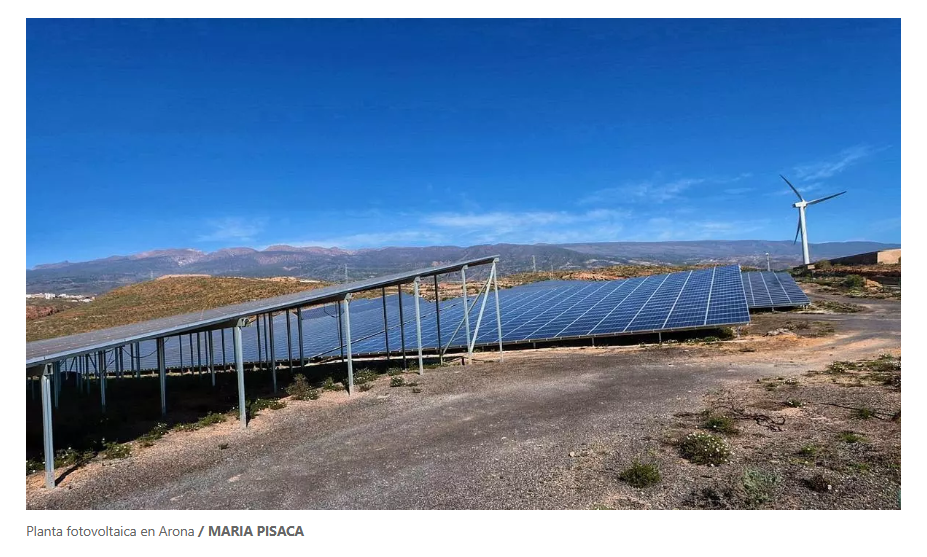
A new solar park planned for Arona has been given the green light by the Canary Islands government, despite objections from the local council over the use of protected agricultural land.
The La Estrella solar park, developed by Iberdrola Renovables Canarias, will have an authorised output of 4.5 megawatts and represents an investment of around €3.41 million.
The decision was approved on 5 October using an exceptional procedure under the Canary Islands’ Electricity Sector Law. This allows the project to move forward despite disagreements with existing planning rules.
Why is the council objecting?
Arona Council has argued that the proposed site is classified as environmentally protected agricultural land under the municipality’s current General Plan.
In its view, the development is incompatible with the existing planning framework. The council has also raised concerns about possible effects on public footpaths and the construction of new internal roads.
The Cabildo de Tenerife has flagged additional issues, including the justification for earthworks, how the solar park will fit into the surrounding landscape and whether the development is compatible with existing water infrastructure.
Despite these concerns, the regional government has decided that the project can proceed. The planning framework will need to be amended in future to accommodate the facility.
What will the solar park include?
The development will feature 7,743 solar panels mounted on fixed structures, alongside 13 inverters and a transformation centre.
Although the installation has a peak capacity of 5.4 megawatts, its declared output is 4.5 megawatts, with an operational limit of 3.99 megawatts.
Electricity will be carried through an underground connection operating at 20 kilovolts.
How much energy will it produce?
The government estimates that La Estrella will generate around 9,997 megawatt-hours of electricity each year.
That production is expected to reduce carbon dioxide emissions by approximately 6,189 tonnes annually.
The regional government says accelerating renewable energy projects is essential to reducing the Canary Islands’ reliance on conventional energy sources, cutting emissions and lowering the additional costs associated with the islands’ electricity system.
Tenerife still has some catching up to do on solar power. The island has installed 158 megawatts of photovoltaic capacity against a target of 343.2 megawatts by 2030.
Renewable energy versus land-use concerns
The decision highlights a familiar challenge for Tenerife: finding suitable locations for renewable energy projects while protecting agricultural land, landscapes and existing infrastructure.
The government has prioritised moving La Estrella forward without the usual urban development licence, using its exceptional powers under regional electricity legislation.
However, the concerns raised by Arona Council and the Cabildo show that questions remain about the project’s impact on the surrounding area.
The approval is an important step for the development, but it also demonstrates the tensions that can arise as Tenerife tries to expand renewable energy production while balancing other land-use priorities.