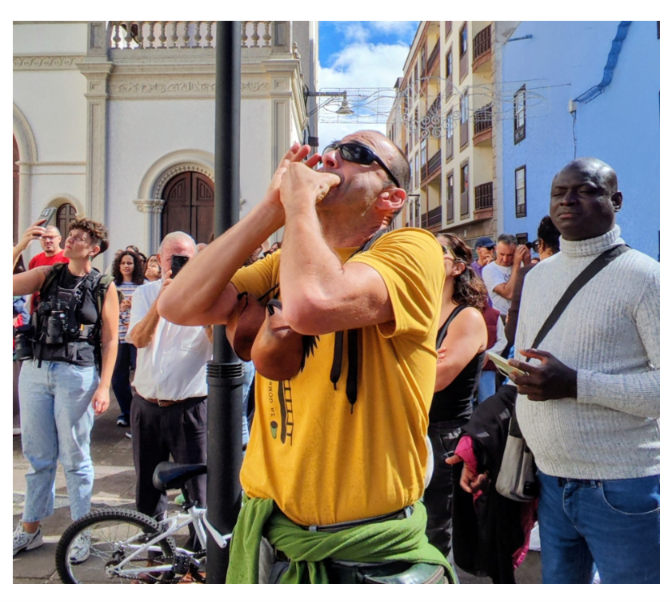
On Sunday 15 November, whistles echoed around La Laguna’s old town. Patrimonios Hermanados (Twinned Heritage) was back, an event that brings together two of the Canary Islands’ UNESCO-recognised treasures: the historic city of La Laguna and the Silbo Gomero.
If you’ve not come across it before, the Silbo Gomero is La Goma’s whistled language. Islanders used it to send messages across deep ravines long before anyone had a mobile phone. Some still can, and they’re very good at it.
Why La Laguna and La Gomera?
Because the two places share a lot of history. Over the years, thousands of people from La Gomera moved to La Laguna and helped shape the town.
The event was organised by the Asociación Cultural Silbo Gomero with help from La Laguna town hall’s Cultural Heritage department. It brought together whistlers from across the islands, along with locals, visitors and a handful of officials.
The timing was deliberate. It fell on the eve of International World Heritage Day and marked two anniversaries. La Laguna was declared a World Heritage City 27 years ago, and the Silbo Gomero was recognised as Intangible Cultural Heritage of Humanity 17 years ago.
Messages sent across the town
The day began with whistled messages sent between different points around the old town. It still surprises people how far a well-whistled message can carry.
The most symbolic moment came when the first message got a reply from the balcony of the Casa de los Capitanes. Two pieces of world heritage, quite literally talking to each other.
The mayor of La Laguna, Luis Yeray Gutiérrez, was there with the councillor for Cultural Heritage, Adolfo Cordobés. They were joined by Adelma Méndez Enríquez of the Asociación Cultural Silbo Gomero and Rogelio Botanz, who started the initiative.
The mayor described Patrimonios Hermanados as one of the most unusual dates in La Laguna’s cultural calendar. He also paid tribute to the Gomeran families who helped build the town, saying today’s La Laguna is the product of many generations’ work.
Keeping it alive for the next generation
Cordobés spoke about bringing heritage closer to people, so it feels part of everyday life rather than something behind glass.
Méndez Enríquez pointed out that the Silbo Gomero is still very much alive, and that it’s down to younger generations to keep it that way. Events like this, she said, strengthen the bonds between the two islands and pass on a shared history.
A tribute to Juan Magdalena
The most moving part of the day took place in the Plaza de la Catedral. The association paid tribute to Juan Magdalena, a 91-year-old whistler and poet from La Laguna.
Magdalena came back to Tenerife last year after living in Venezuela for more than seven decades. The tribute recognised a lifetime spent on Canarian popular culture and keeping the silbo going.
His story will be familiar to many Canarian families. Huge numbers emigrated to Venezuela over the years, and many held on to their roots on both sides of the Atlantic. The crowd gave him a long, warm round of applause.
Botanz reminded everyone that the initiative was created to highlight the historic link between La Gomera and La Laguna, and the contribution of thousands of Gomerans to life in the town.
Whistled telegrams
The programme carried on with whistled tours of some of the old town’s best-known buildings. It’s a clever idea, linking the architecture you can see with a tradition you can only hear.
There were also the popular Telegramas Silbados (whistled telegrams). Locals and visitors suggested messages, and the whistlers sent them between different spots around town.
UNESCO status is all very well, but it’s the people who keep these traditions going. A 91-year-old poet getting a standing ovation in the cathedral square says more about that than any certificate.