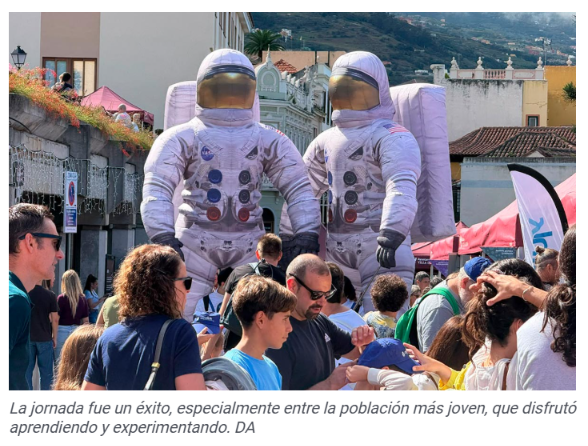
More than 17,000 people visited the 23rd Science Fair in La Orotava on Sunday 15 November. That’s the biggest turnout in the fair’s history, and it makes it one of the most important science events in the Canary Islands.
From 10:30 to 18:30, families wandered around the town’s historic centre. Activities were spread across the Plaza de la Constitución, Calle Escultor Estévez and the Sala San Roque.
Who was taking part?
The fair grew this year in size and reach, with 33 organisations involved. These included universities, research centres, scientific bodies, associations, schools and innovation projects from around the islands.
Between them they covered just about every branch of science you can think of. There was astronomy, chemistry, biology, geology, maths, robotics, neuroscience, oceanography and environmental science. Alongside that came the newer stuff: artificial intelligence, virtual reality, 3D printing and drones.
What drew the biggest crowds?
A few things stood out. Looking at the sun through specialist telescopes was popular, as were the volcanology and volcanic risk workshops. On an island with Teide in the middle of it, that’s always going to get people’s attention.
There were also activities on plastic pollution and ocean acidification, plus sessions explaining how the brain and nervous system work.
Sustainability had its place too, with stands on agricultural biodiversity, water management, recycling waste and the UN’s Sustainable Development Goals.
Doing, not just looking
The idea behind the fair is simple. Visitors don’t just watch, they take part, ask questions and see how science turns up in everyday life.
The aim is to spark an interest in science, especially among young people. And to show that you don’t need a lecture hall to learn something.
Several new organisations joined this year, and the programme also included talks and book presentations for anyone who wanted to go a bit deeper.
Who’s behind it?
The fair is part of the Canary Islands Science and Innovation Weeks. It’s organised by La Orotava town hall and Cienciamanía, with support from the Tenerife Science and Technology Park, Canalink and the Canary Islands Government’s research and innovation agency.
It’s been running since 2003, with the same goal from day one: take science out of the laboratory and put it on the street, where anyone can get involved.
It’s picked up a few awards along the way. These include the Ciencia en Acción prize, linked to the CSIC (Spain’s national research council), and the science communication award from the Official College of Chemists of the Canary Islands in 2024.
Twenty-three years in and it’s still growing. Mad but true, a science fair is one of the busiest days out in the north of the island.