Tenerife’s extraordinary plant life is being studied for naturally occurring compounds that could eventually contribute to the development of new medicines and other valuable products.
The project, known as the Librería de Productos Naturales de Tenerife (LiPNaT), brings together the Tenerife Cabildo and Spain’s Consejo Superior de Investigaciones Científicas (CSIC) through the Instituto de Productos Naturales y Agrobiología (IPNA).
The idea is pretty simple, although the science behind it is anything but.
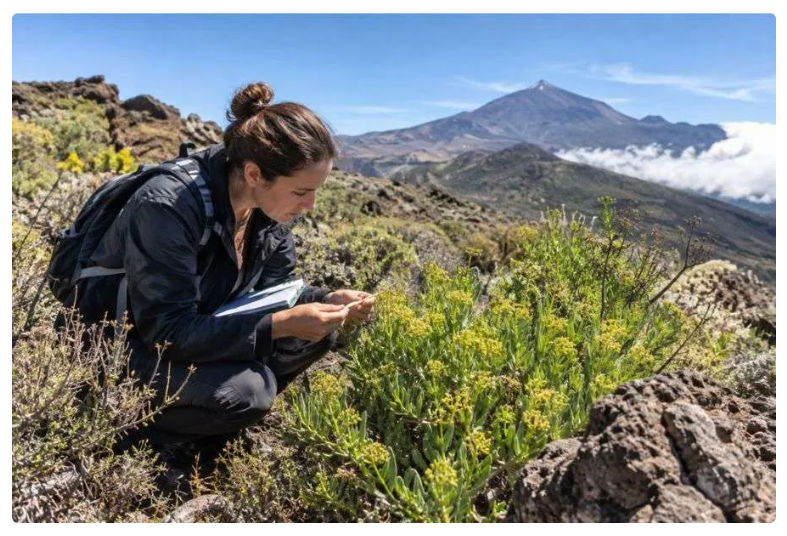
Researchers are creating a scientific library of natural products and compounds derived primarily from the plant biodiversity found across Tenerife and the wider Canary Islands.
Looking inside Tenerife’s plants
The Canary Islands are home to an unusually diverse range of plants, including a significant number of species found nowhere else.
Plants produce all sorts of chemical compounds naturally as they deal with drought, pests, competition and the environmental conditions around them.
Scientists can isolate these compounds and study their properties to see whether they could have useful scientific, medical or commercial applications.
That doesn’t mean someone has discovered the next miracle medicine growing in a Tenerife garden.
The project is about building the scientific knowledge and collection that could allow researchers to identify promising compounds and investigate them further.
€1.2 million from the Cabildo
The Tenerife Cabildo has committed €1.2 million to the project under its agreement with the CSIC.
The funding is scheduled across 2027 and 2028, with €600,000 allocated in each year.
It will support researchers and technical staff, laboratory materials, specialist services and other costs involved in the scientific work.
The CSIC will also provide personnel, laboratory facilities, specialist equipment and other resources.
Together, the resources committed by both institutions are valued at approximately €1.88 million.
It’s more than collecting plants
The researchers won’t simply be wandering around Tenerife collecting leaves and putting them in jars.
The work involves identifying the plant species, carrying out genetic and genomic analysis, isolating and purifying chemical compounds and studying their structures.
Samples will then be organised within the scientific library, while relevant plant specimens will be preserved under controlled conditions.
This creates a lasting scientific record of the material being studied.
And that’s important because the aim is for the collection to be useful beyond the initial research team.
The resulting knowledge could eventually be transferred to businesses and other organisations interested in developing products with added value.
In other words, a compound identified during the research could become the starting point for much more research further down the line.
Why Tenerife is interesting
Tenerife and the Canary Islands have a rather useful advantage when it comes to this sort of research.
The islands’ geographic isolation and range of habitats have helped create a remarkable level of biodiversity, including many endemic species.
LiPNaT is essentially taking that natural heritage and looking at it on a molecular level.
Whether any particular compound eventually becomes part of a medicine is another matter entirely. Any promising discovery would still require years of laboratory research, testing and development.
But the project could reveal that Tenerife’s plants have more to offer than their obvious beauty.
There may be some very interesting chemistry hiding in there as well.