Tenerife is getting ready for something that nobody wants to experience for real.
On Friday 25 September, Garachico will become the setting for EU-Modex Tenerife 2026, Spain’s first full-scale volcanic eruption emergency exercise.
The scenario will simulate a volcanic crisis developing in the north of Tenerife, from increased volcanic activity through to an eruption affecting local communities and visitors.
Before anyone starts checking the volcano webcams, this is an exercise, not a prediction. There is no indication that an eruption is expected.
Why Garachico?
Garachico is a fairly obvious choice for a volcanic emergency exercise because the town already knows what happens when Tenerife’s volcanoes get involved.
In 1706, the Trevejo, or Arenas Negras, eruption sent lava towards Garachico, destroying much of the town and its harbour.
At the time, that harbour was Tenerife’s main commercial port.
More than 300 years later, the same area will provide the fictional setting for testing how today’s emergency services would respond to a similar threat.
The exercise will look at the different stages of a volcanic emergency, including scientific monitoring, communication between authorities, public warnings, evacuations and the deployment of specialist resources.
And this won’t just be people sitting around a table moving little markers across a map.
Residents in selected areas will also take part, making the exercise considerably closer to what a real emergency might look like.
Around 1,000 people involved
Around 1,000 people are expected to participate, including local residents and personnel from a wide range of organisations.
These will include emergency services, firefighters, police, Civil Protection, health services, scientists and specialist teams from the Canary Islands, together with European emergency-response resources.
One of the aims is to test what happens when an emergency becomes too large for local resources to handle on their own and additional assistance needs to be brought in through European civil-protection mechanisms.
That’s particularly relevant for an island.
Getting specialist people, vehicles and equipment onto Tenerife isn’t quite as simple as sending them down the motorway from the next province.
Emergency alerts will also be tested
Another important part of the exercise will be the testing of the ES-Alert emergency warning system.
The system allows Civil Protection authorities to send urgent messages directly to compatible mobile phones within a defined geographical area.
It’s particularly relevant for Tenerife because the island isn’t just home to residents. Millions of tourists visit every year.
Visitors don’t need to register their phone number with a Spanish authority to receive an ES-Alert message. Compatible phones connected to mobile networks in the affected area can receive the warning automatically.
So if you’re in or around Garachico during the exercise and your phone suddenly starts making an alarming noise, don’t immediately assume the volcano has decided to make an appearance.
Simulated warnings and evacuations will form part of the exercise.
Lessons from La Palma
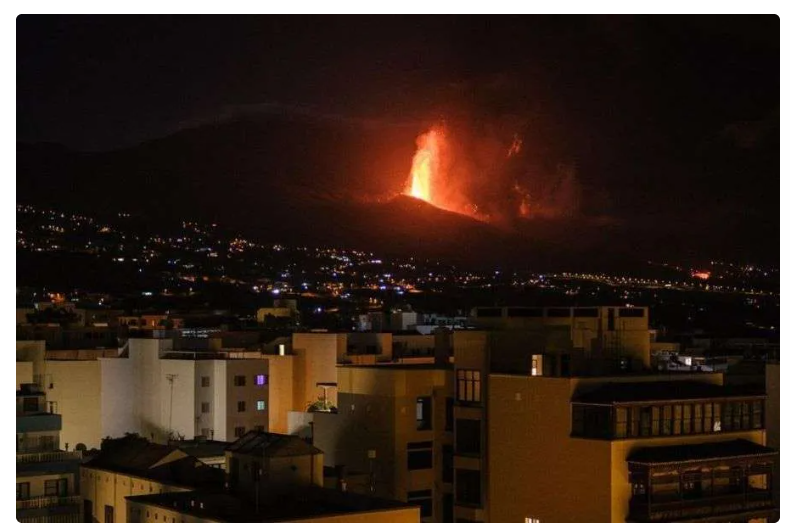
The operation comes almost exactly five years after the Tajogaite eruption on La Palma, which began on 19 September 2021 and continued for almost three months.
Thousands of people were forced to leave their homes, while the eruption destroyed houses, roads, businesses and agricultural land.
Tenerife and La Palma have different volcanic systems and risk scenarios, but the La Palma eruption gave authorities plenty of real-world experience in areas such as evacuation, exclusion zones, scientific monitoring, emergency accommodation and communicating with residents.
This exercise provides an opportunity to put some of those lessons through their paces without anyone actually having to deal with lava flowing down the road.
Preparedness, not prediction
Volcanic activity in the Canary Islands is continuously monitored, and small earthquakes beneath and around the islands can sometimes attract attention.
But that’s precisely why monitoring systems exist.
The EU-Modex Tenerife 2026 exercise does not mean Tenerife is facing an imminent volcanic eruption.
Its purpose is much more straightforward.
To test whether emergency services, authorities, scientists and the public know what to do if a serious volcanic emergency ever does happen.
For an island with a large resident population and millions of visitors, that’s a useful exercise to have completed before it’s ever needed.
And hopefully, the next time Garachico sees an eruption, it remains firmly in the history books.