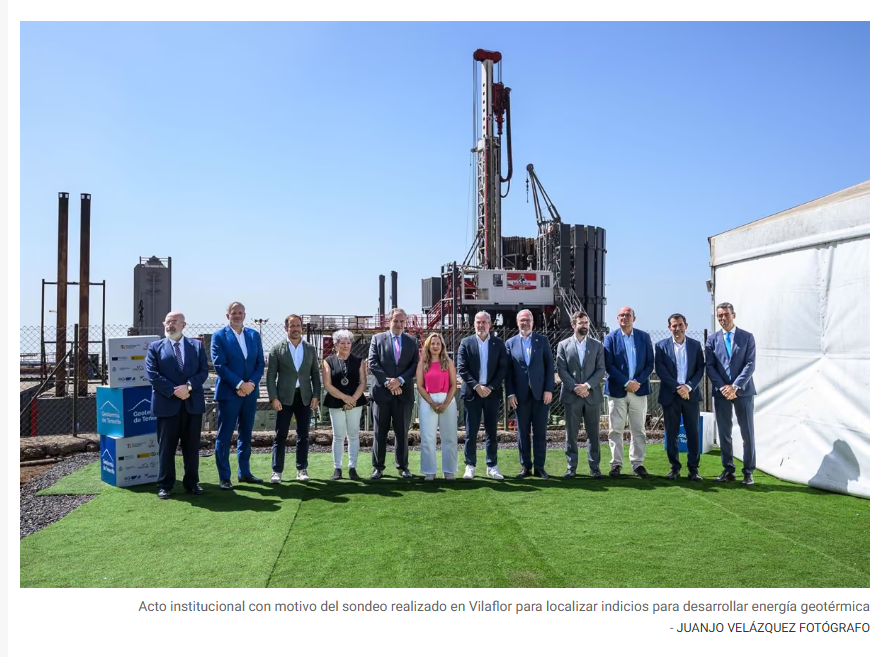
Tenerife’s geothermal energy project has produced encouraging results, with drilling near Vilaflor uncovering hot water, high pressure and underground fractures at depths of around 3,000 metres.
The findings have prompted the central government to commit to developing a regulatory framework aimed at supporting geothermal energy projects across the Canary Islands.
Joan Groizard, Secretary of State for Energy, announced the funding and regulatory plans during a visit to the drilling site in the Trevejos area. He highlighted the potential of using the islands’ volcanic origins to generate energy.
And given that Tenerife has spent millions of years sitting on top of volcanic activity, it would be nice if we could put some of that underground heat to good use.
Hot Water and High Pressure Found Underground
The Vilaflor project is the first of nine geothermal exploration initiatives backed by the Spanish government, with public-private partnerships playing a central role.
The drilling consortium includes:
- Tenerife Cabildo.
- DISA.
- Reykjavík Geothermal.
European funding is covering 50% of the project costs, equivalent to €14.5 million.
So far, drilling has revealed fractures containing high-pressure fluids with temperatures above 100°C. This suggests that a hydrothermal reservoir may be present beneath the site.
However, the eventual energy potential remains uncertain. Researchers will need to establish the size and final temperature of the reservoir in the coming months before determining how much electricity and thermal energy it could produce.
Could Geothermal Reduce Electricity Costs?
One of the main attractions of geothermal energy is its ability to generate power continuously, unlike renewable sources that depend on sunshine or wind conditions.
The government estimates that geothermal development could eventually save the Canary Islands more than €130 million per year in electricity costs.
Canary Islands President Fernando Clavijo described geothermal energy as a strategic partner in improving economic sustainability and local living standards.
He also pointed out that reducing dependence on imported fuels could benefit households directly, as lower fuel costs could eventually translate into reduced electricity bills.
Mariano Hernández Zapata, the regional minister for Ecological Transition, described the project as an example of the future direction of energy in the islands, combining innovation with the use of local resources.
Cabildo President Rosa Dávila also welcomed the drilling results, describing them as a significant opportunity for Tenerife.
Calls for a Fixed Geothermal Energy Tariff
DISA CEO Demetrio Carceller said the findings provide strong indications of a geothermal system with energy potential in the Canary Islands.
However, he argued that additional tariff regulation is needed to support further exploration.
He pointed to the Azores and Germany, where fixed tariffs for geothermal energy have helped support exploratory activity. A similar system in the Canary Islands could provide greater certainty for companies investing in what remains an expensive and technically challenging process.
Magnus Ásbjörnsson, CEO of Reykjavík Geothermal, stressed the importance of taking a careful approach when developing geothermal resources.
Iceland’s ambassador, Kristján Andri Stefánsson, also highlighted the project’s role in building confidence and long-term commitment to cleaner energy.
Eight More Projects Underway
The Vilaflor site is not the only geothermal project being developed in the Canary Islands.
Eight additional deep exploration projects are underway across:
- Tenerife.
- La Palma.
- Gran Canaria.
All are backed by European funding and public-private collaboration.
There is still a fair amount of drilling, testing and paperwork to get through before geothermal energy starts making a noticeable contribution to the islands’ electricity supply.
But the discovery near Vilaflor suggests that Tenerife’s volcanic foundations could eventually become part of a more locally produced and less fuel-dependent energy system.