
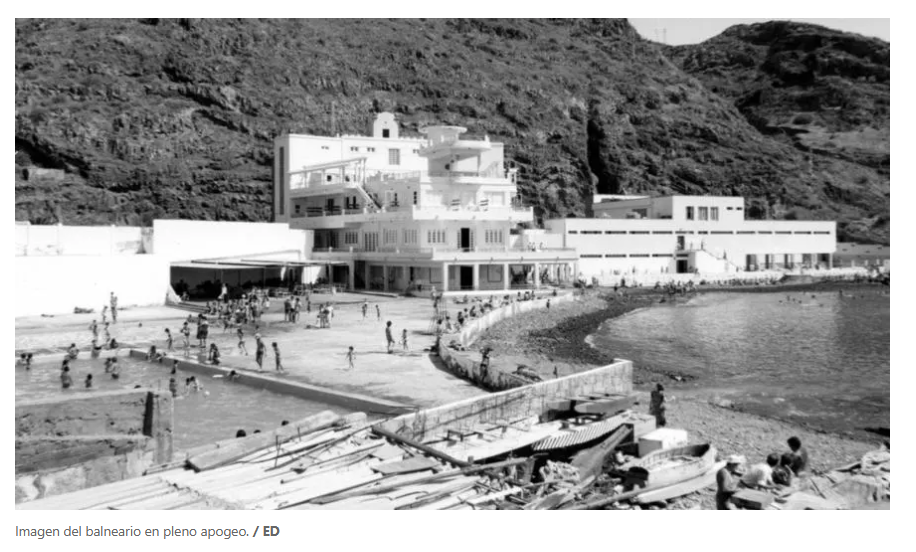
Few places in Santa Cruz de Tenerife evoke as much nostalgia as the old Balneario de Santa Cruz, a seaside complex that holds a special place in the memories of generations of chicharreros who spent their childhoods and summers there.
Its story began in 1928 when then-mayor Santiago García Sanabria lamented the lack of a proper bathing facility in the island’s capital. Determined to change that, a group of local residents formed a company to build a maritime leisure complex where people could enjoy the sea.
Construction started that same year in Valleseco and was completed in 1930. Designed by architect Domingo Pisaca Burgada, the complex included a main building, a small pier, three swimming pools, tennis and fronton courts, and a black-sand beach.
The Birthplace of Swimming in Tenerife
The Balneario soon became much more than a leisure facility. It is widely regarded as the birthplace of competitive swimming in Tenerife.
On 25 July 1934, coinciding with the inauguration of its Olympic-sized pool, the venue hosted the Canary Islands Swimming Championships and saw the creation of the Club Natación Balneario. Later that year, the club organised Tenerife’s first provincial swimming championship.
For decades, it remained the only Olympic swimming pool in Santa Cruz and helped develop athletes who would go on to compete nationally and internationally.
The Balneario eventually closed its doors in 1992.
The José Miguel Delgado Rizo Holiday Residence
Adjacent to the Balneario stood another cherished facility: the José Miguel Delgado Rizo Education and Recreation Residence.
Originally built as a hotel-casino in 1954, it became part of Spain’s social tourism programme, offering affordable summer holidays to working families.
Named after swimmer José Miguel Delgado Rizo, whose sporting career was cut short when he died serving with the Blue Division during the Second World War, the residence could accommodate around 100 individual guests and 90 family groups.
During the summer months, occupancy regularly reached 700 people, and over its 26 years of operation more than 40,000 guests stayed there.
Families spent their holidays swimming, playing sports, attending dances and social events, and taking excursions around the island. Full-board accommodation cost just 10 pesetas per family member, making it accessible to many working-class households.
For countless Tenerife residents, it represented their first holiday experience.
Years of Abandonment and Preservation Efforts
After decades of neglect, ownership of the complex was transferred from the Spanish State to the Canary Islands Government in 2013.
The move followed campaigns led by local residents and the platform Salvar el Balneario, which sought to preserve the site and find a new use for it.
Various proposals have emerged over the years, including transforming the building into a health centre serving the Anaga district. The idea received unanimous support in the Canary Islands Parliament in 2023.
However, the project was ultimately ruled out after the Port Authority concluded that healthcare facilities would be incompatible with nearby fuel storage terminals and port operations.
An Uncertain Future
The Balneario and the neighbouring residence remain protected within Santa Cruz’s municipal heritage catalogue, and several organisations have repeatedly argued for greater protection and restoration of the site.
Today, the property has returned to the Canary Islands Government’s Heritage Department, which is consulting with various public bodies to determine possible future uses.
For many residents, however, the Balneario’s true value lies beyond bricks and mortar. It remains a place filled with memories of swimming lessons, family holidays, summer friendships and a chapter of Santa Cruz history that continues to hold deep sentimental significance more than three decades after its closure.