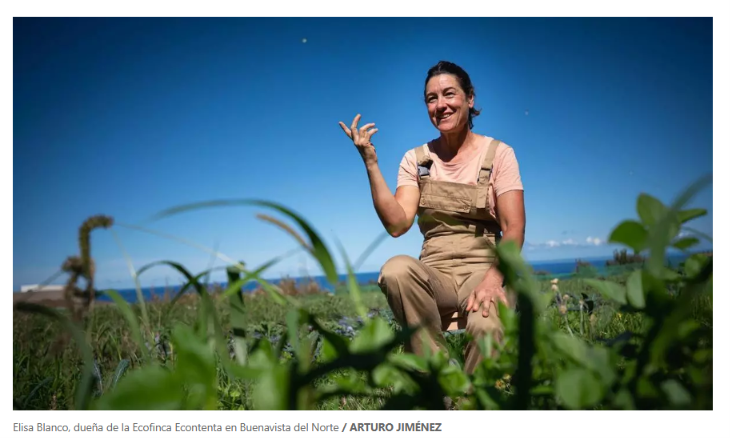
“If they want people to work in agriculture, they need to take action.” That’s the message from Elisa Blanco, owner of Ecofinca Econtenta, who is calling for more support for farmers and a better future for organic agriculture in the Canary Islands.
Blanco recently received the Agricultural Woman of the Year award from Buenavista del Norte Council during the Rural Women’s Days at the University of La Laguna.
It’s recognition she appreciates, particularly because agriculture still struggles to attract the attention and new people it needs. But an award doesn’t solve the problems facing those trying to make a living from the land.
From biology to organic farming
Blanco originally studied Biology, but soon realised that spending her working life indoors wasn’t going to suit her.
After several years working as an outdoor activity guide, she rediscovered her interest in plants and began exploring opportunities to grow organic fruit and vegetables with a group of friends.
When the opportunity came along to open a local market in Los Silos, they decided to take things a step further and grow the produce themselves.
That was the beginning of Econtenta, a farm whose name was inspired by an American film.
For Blanco, the word ‘eco’ is more than a label. It means committing to organic farming methods and using natural products rather than synthetic chemicals. Despite the challenges along the way, she has managed to maintain the farm’s organic certification.
Fresh produce delivered to local families
Today, Econtenta supplies fresh produce baskets to almost 50 families every Wednesday across Buenavista del Norte, Los Silos and Garachico.
The farm also works alongside a network of seven local organic producers.
By selling directly to customers, the group reduces the number of intermediaries involved, allowing a greater share of the money to reach the people actually growing the food.
It’s a straightforward idea, but one that makes a real difference to small producers trying to compete in an increasingly difficult market.
The challenges facing a new generation of farmers
Despite her own progress, Blanco is concerned about the future of agriculture in Tenerife.
She believes the obstacles facing people who want to enter the sector are becoming increasingly difficult to overcome. The cost of agricultural land is one major problem, alongside the general lack of support for those trying to establish themselves.
Her message to public authorities is clear: if they genuinely want more people working in agriculture, they need to do something practical about it.
She is particularly keen to see incentives that encourage people to enter the sector and make it easier for younger generations to take over from established farmers.
There are also changes happening in the crops themselves. Traditional produce such as oranges has increasingly been replaced by bananas because of market demand, creating further challenges for those trying to maintain a more diverse agricultural landscape.
Recognition is welcome, but action is needed
Blanco welcomes the Agricultural Woman of the Year award because it helps bring visibility to the work being done by women in the primary sector.
But she is also realistic about what needs to happen next.
Small organic farms such as Econtenta demonstrate that alternative farming methods can work, particularly when producers build direct relationships with local customers.
The bigger question is whether enough will be done to make agriculture an attractive and viable career for the next generation.
Because without new people coming into the sector, some of the traditional farming knowledge and local produce that make Tenerife special could gradually disappear.