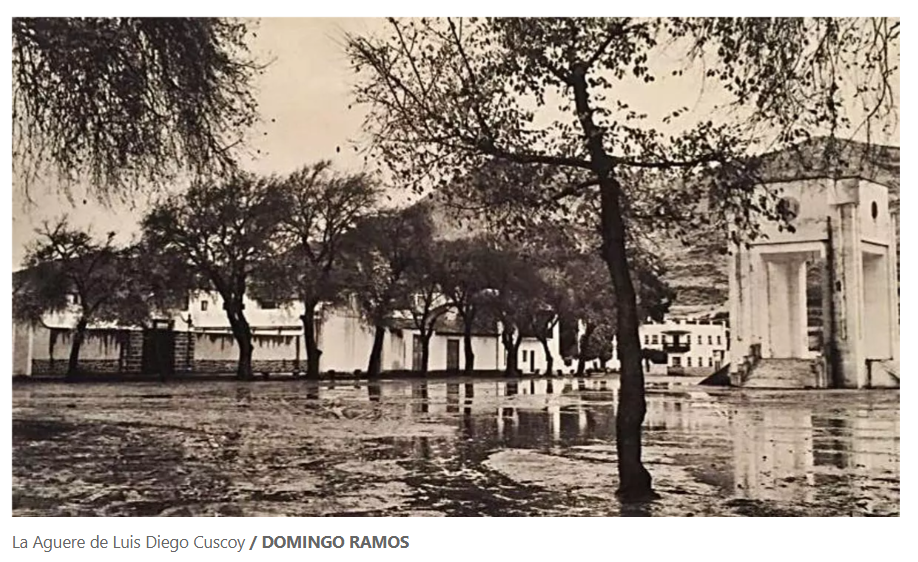
Luis Diego Cuscoy documented a Tenerife that was already beginning to disappear, and warned about the impact tourism could have on the island’s landscape, traditional trades and rural way of life
Long before mass tourism transformed Tenerife, Luis Diego Cuscoy (Girona, 1907 – La Laguna, 1987) was already documenting the island as it changed.
He photographed farmers, fishermen, shepherds and craftspeople. He recorded traditional ways of life and spent time in landscapes that would later be transformed by tourism development.
But Cuscoy was not simply interested in preserving the past.
He also recognised that the economic changes arriving in Tenerife during the middle of the 20th century could come with a price.
The archaeologist, photographer, teacher, journalist and ethnographer warned about the abandonment of the countryside, the disappearance of traditional trades and the transformation of landscapes that had existed for generations.
A man who did far more than archaeology
Cuscoy is probably best known in Tenerife for his archaeological work and his research into the island’s Guanche population.
But according to Juan Francisco Navarro Mederos, archaeologist and retired professor at the University of La Laguna, that represents only part of his work.
Navarro describes Cuscoy as an exceptionally versatile figure who was also a poet, educational theorist, journalist, ethnographer, anthropologist, photographer and naturalist.
Researchers have identified at least 374 articles written by Cuscoy for newspapers and magazines in the Canary Islands and elsewhere in Spain.
Through those writings and his photography, he documented the transition from a predominantly rural society to one increasingly shaped by tourism and a changing economy.
And he wasn’t blind to what was happening.
Cuscoy saw the cost of tourism
Cuscoy understood that tourism could bring economic improvements to Tenerife, but he also saw the risks.
He wrote about the abandonment of agriculture, the disappearance of traditional crafts and the transformation of landscapes that had previously been closely connected to the people who lived and worked there.
His photographs of potters in Tenerife and La Gomera, fishermen, shepherds, agricultural workers and traditional craftspeople have become particularly valuable because they preserve images of a world that has largely disappeared.
He was effectively photographing the future before it arrived.
His concerns also extended to the south of Tenerife, where he documented the arid landscapes and criticised the destruction of natural monuments and geological formations caused by tourist development.
Navarro sees some similarities between Cuscoy’s concerns and those of César Manrique, although there was an important difference. Cuscoy was primarily documenting and questioning what was happening rather than proposing an artistic or architectural alternative.
The Cañadas before the crowds
One of the places where the changes would probably have affected Cuscoy most strongly is Las Cañadas del Teide.
He visited the area regularly and wrote about its solitude, silence and lack of noise.
Today, the scale of tourism around Teide would present a very different experience.
Navarro believes the massification of Las Cañadas is one of the changes that would have surprised or saddened Cuscoy most.
The same applies to the southern coastline of Tenerife.
The dry landscapes he once walked through and photographed have been dramatically altered by decades of tourism development.
Many of the issues he identified in the 1960s and 1970s still sound remarkably familiar, including the pressure created by a tourism-based economy and the vulnerability of Tenerife’s natural and rural landscapes.
Working under Franco
Cuscoy’s career was also shaped by the political reality of the time.
According to Navarro, he was a man of left-wing views and at least agnostic. When the Civil War began, he was reported by a fellow teacher for being left-wing and anti-Christian.
He was subsequently subjected to professional sanctions and had to rely on the protection of family members and priests he knew.
His writing changed as a result.
His articles from the 1920s and 1930s addressed issues including rural poverty, poor access to education, social abuses and militarism.
During the early years of Franco’s dictatorship, his writing became considerably more cautious.
Navarro describes this period as a form of “funambulism”, with Cuscoy sometimes using irony and poetic language to disguise social criticism and avoid attracting unwanted attention.
His archaeological work was also influenced by the political climate, although Navarro believes Cuscoy gradually moved away from the official thinking of the regime.
The man who helped shape the image of the Guanche
Cuscoy’s archaeological work remains an important part of Tenerife’s history.
Although some of his conclusions have since been overtaken by advances in archaeological research, his contribution to public understanding was enormous.
He helped bring the ancient inhabitants of Tenerife into the public consciousness and played an important role in the creation of the Museum of Archaeology of Tenerife.
He also recognised Las Cañadas del Teide as an important archaeological area and drew attention to rock engravings in La Palma and El Hierro.
His influence went beyond academic research.
For generations of Canarians, the image of the Guanche was shaped partly by Cuscoy’s writing, including his portrayal of the Guanches as a predominantly pastoral society and his links between ancient pastoralism and traditional island shepherds.
In that sense, Cuscoy did something rather unusual.
He didn’t just study Tenerife’s past.
He helped shape the way Tenerife understood it.
A legacy that feels surprisingly current
There is something particularly interesting about looking back at Cuscoy’s work now.
He was photographing traditional Tenerife at the very moment the island was beginning a dramatic economic and social transformation.
He saw the benefits of development, but he also noticed what was being lost along the way.
The old agricultural landscape. Traditional trades. Quiet coastlines. Rural communities. And eventually, the sense of isolation that once defined places such as Las Cañadas.
His photographs are therefore more than historical records.
They are a reminder of how quickly a place can change.
And perhaps that’s why Cuscoy’s work still feels relevant in Tenerife today. The questions he was asking decades ago about tourism, landscape, identity and what happens when development moves faster than the culture around it haven’t exactly gone away.