Some traditions change with the times. Others somehow manage to keep their identity while changing just enough to stay relevant.
That’s exactly what happens with the Santa Bárbara celebrations in Icod de los Vinos, where colourful baskets, enormous decorated breads and plenty of local pride come together every year.
On 29 August 2026, residents once again took part in one of the town’s most distinctive traditions, dating back to 1945.
A procession with plenty of weight behind it
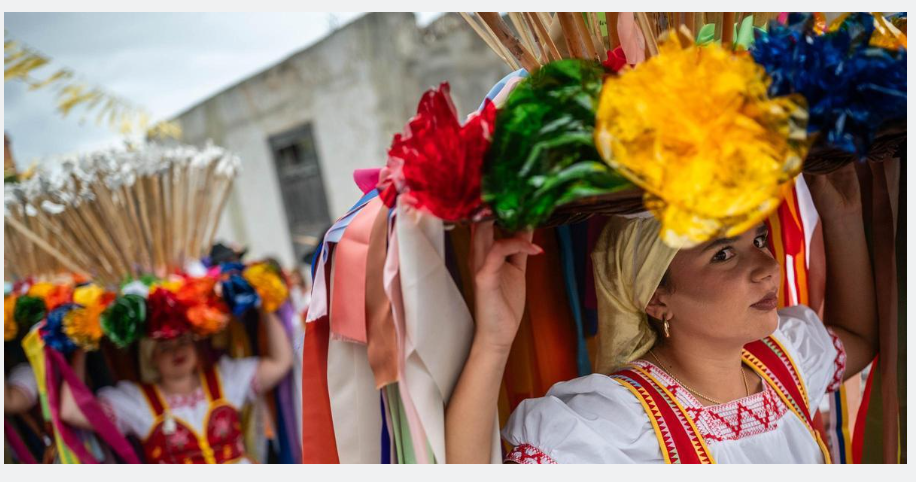
The tradition centres around the cestos, decorated baskets filled with fruit and vegetables, and large sweet breads carried through the streets to the local church.
Twelve young women, known as provideras, traditionally lead the procession. Each represents a letter associated with their neighbourhood, with the baskets decorated with ribbons, sweets and plenty of imagination.
And these aren’t exactly lightweight props.
Some of the breads weigh between 10 and 15 kilos, meaning the provideras need a fair amount of help along the route.
The procession begins in Lomo Blanco, stopping at a local pine tree where the baskets can be unloaded temporarily and the participants get a chance to catch their breath.
Fair enough. Carrying a 10-kilo loaf through Icod isn’t quite the same as popping down to the bakery.
From finding a husband to carrying on the tradition
The meaning behind the celebration has also changed over the years.
Traditionally, the young women taking part would ask Santa Bárbara for a good husband.
These days, that’s not necessarily the priority.
For many of the participants, it’s simply about keeping a family and community tradition alive.
Lucía Socas Fuentes, one of this year’s provideras, explained that she was taking part because her mother and sister had done the same before her.
Her own wish was rather more straightforward: health for her grandmothers.
That perhaps says quite a lot about how traditions evolve. The ritual remains, but people give it their own meaning.
A tradition passed from one generation to another
Sara Méndez Delgado, another participant, described the celebration as one of the most beautiful traditions in Icod de los Vinos and something that should not be allowed to disappear.
She grew up watching other young women take part and now has the opportunity to continue the tradition herself.
The role of the companions has also changed.
Rather than the event being centred around romantic relationships, participants can now choose friends and family members to accompany them.
It’s less about finding a husband and more about celebrating the people around you.
Probably an improvement.
The baskets have become works of art
While the basic idea has remained intact, the presentation has certainly moved on.
Local artisans now create increasingly elaborate designs for the baskets, combining flowers, fruit, vegetables, sweets and other decorative elements.
The result is a procession that is as much about craftsmanship and creativity as it is about religious tradition.
It’s also a good example of how Tenerife’s smaller festivals continue to survive. They don’t need to remain frozen in the past. They simply need people willing to keep turning up and carrying them forward.
In Icod de los Vinos, the Santa Bárbara cestos and breads continue to do exactly that.
Almost 80 years after the tradition began, the baskets are still being carried, the breads are still being made and another generation is learning why it matters.
And thankfully, nobody seems to have decided that a 15-kilo loaf of bread is an unnecessary part of the experience.