
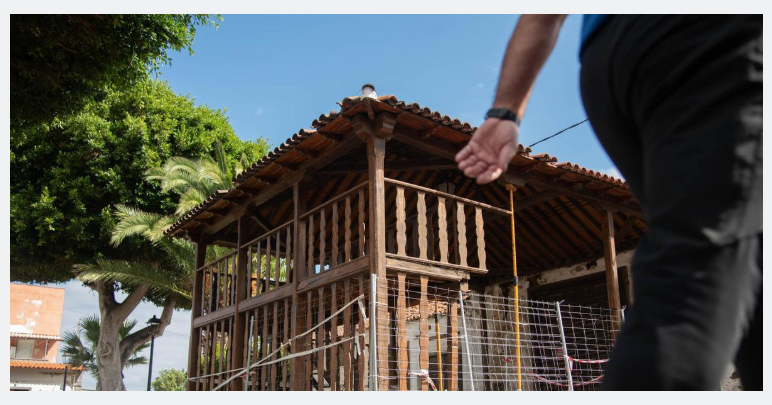
Most visitors to Tenerife will walk past them without giving them a second thought.
Yet scattered around Icod de los Vinos are several architectural features that tell an unusual story about the town’s history, its Portuguese roots and the way practical rural design found its way into religious buildings.
They’re known locally as “medias naranjas”, although their original name is alpende.
What Is an Alpende?
Traditionally, an alpende was a simple covered structure used in rural life.
Across the Canary Islands, these porches provided shelter for people, livestock, tools and agricultural equipment. They were a common sight on farms and estates, offering protection from the sun and rain while serving as a practical workspace.
In Icod de los Vinos, however, this agricultural feature took on a completely different role.
Instead of sheltering animals or farming equipment, alpendes became part of the town’s religious architecture, creating covered spaces outside churches where worshippers could gather when there wasn’t enough room inside.
A Portuguese Legacy
According to historians Jesús Pérez Morera and Carlos Rodríguez Morales, the presence of these structures can be traced back to the Portuguese settlers who helped shape the municipality during its early development.
Their influence can still be seen in several architectural details throughout Icod, including:
- Whitewashed walls
- Bell tower designs
- Roof structures
- Exterior building volumes
- The distinctive alpende porches
Similar features can be found in churches across Portugal and Madeira, particularly around Funchal, as well as in early colonial churches in Brazil.
Five Churches That Still Preserve Them
Today, five religious buildings in Icod de los Vinos retain these distinctive covered entrances:
Hermitage of Buen Paso
Dating back to the early 16th century, this is considered one of the oldest religious buildings in Tenerife. Its origins are closely linked to the island’s conquest and settlement period.
Church of El Amparo
One of the most striking examples, featuring a rectangular open space supported by stone columns and semi-circular arches, topped with a traditional wooden ceiling and four-sided roof.
Historical drawings from 1792 reveal that the original structure looked quite different and was once open to the sky.
San Antonio de Padua
Built in the early 17th century, its alpende features eight wooden pillars supporting a tiled four-sided roof and traditional coffered wooden ceiling.
San Felipe Neri
Perhaps the most distinctive of all, this 17th-century structure is built entirely from wood and even includes an upper gallery.
Historical records suggest local musicians would perform from this elevated area during religious celebrations and festivals.
San Bernabé
Located in the La Vega area, this early 18th-century example differs slightly from the others, having been constructed using more modern stonework techniques.
More Than Just Architecture
What makes these structures so fascinating is how they represent the blending of cultures that helped shape Tenerife.
A practical agricultural shelter brought from Portugal gradually evolved into a religious architectural feature unique to parts of the island.
Today, these alpendes remain as quiet reminders of a time when daily life, farming traditions and religious practice were closely connected.
For visitors exploring Icod de los Vinos beyond its famous Dragon Tree, they’re a small but fascinating piece of local history that’s easy to miss, yet well worth noticing.