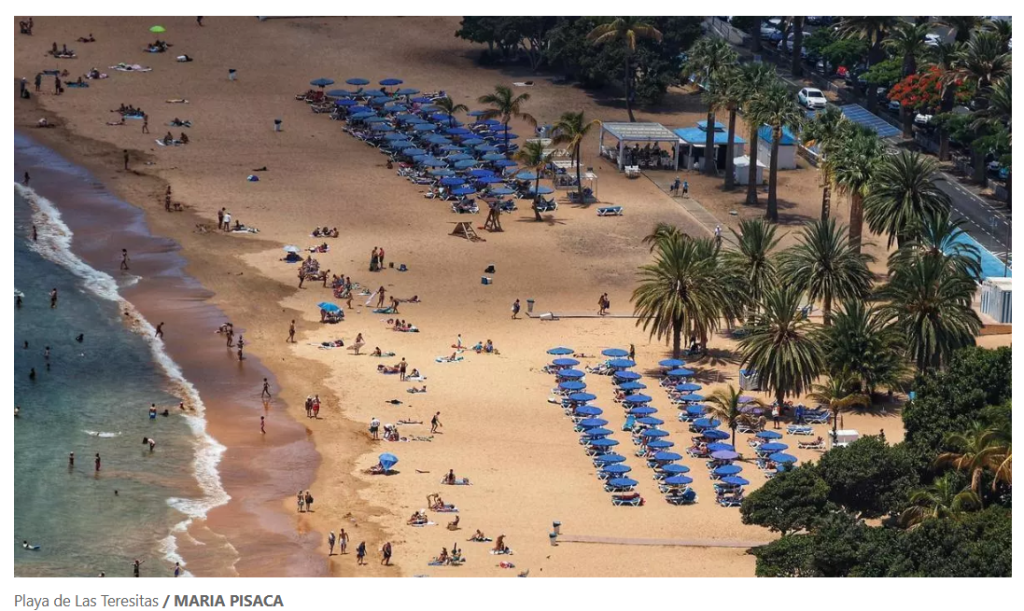
Today, Las Teresitas is one of Tenerife’s most recognisable beaches, attracting thousands of residents and visitors every year. Yet few realise that this iconic golden-sand beach did not always exist in its current form.
Officially inaugurated on 15 June 1973, the creation of Las Teresitas required one of the most ambitious coastal engineering projects ever undertaken in Tenerife, including the importation of five million sacks of sand from the Sahara Desert.
Before Las Teresitas
Half a century ago, the coastline of San Andrés, located around seven kilometres from Santa Cruz de Tenerife, looked very different. The area was made up of three separate beaches: Traslarena, El Moro and Las Teresas, alongside farmland growing bananas, tomatoes, avocados and mangoes.
The original Las Teresas beach, from which the modern beach takes its name, featured black volcanic sand during the winter months, while summer tides often left large pebbles covering much of the shoreline.
The area was also home to a historic residence once used by the Dukes of Württemberg, where members of European nobility spent holidays and even their honeymoon.
A Bold Vision for Tourism
In 1961, Santa Cruz City Council approved plans for a major tourism development along the San Andrés coastline. Construction eventually began in 1967, following the creation of a compensation board representing affected landowners.
The project aimed to create a vast artificial beach measuring approximately 1.3 kilometres long and 80 metres wide.
To achieve this, more than 141,000 cubic metres of sand were transported from the Sahara. The operation required significant investment and became one of the largest coastal transformation projects ever carried out on the island.
Building the Beach
To prevent the imported sand from being washed away by Atlantic currents, engineers created an underwater retaining system extending to depths of 12 metres.
A massive one-kilometre-long breakwater was also constructed using large volcanic rocks. This protective barrier dramatically reduced wave action and helped create the calm waters that Las Teresitas is known for today.
At the time, some locals were sceptical about the imported sand, with rumours even circulating that it contained scorpion eggs. Those concerns quickly disappeared as the beach became increasingly popular.
Las Teresitas Today
When the beach opened in 1973, it included facilities such as parking, showers, kiosks, restaurants, sunbeds, sports areas and children’s zones.
Over the decades, the area has continued to evolve, with palm trees, tamarisks, coconut palms and other exotic species creating the tropical landscape visitors enjoy today. Modern facilities, upgraded restaurants, beach clubs and improved services have helped maintain its status as one of Tenerife’s premier urban beaches.
Today, Las Teresitas serves not only as a popular destination for tourists but also as a daily meeting point for local residents who visit to swim, walk, exercise or simply enjoy the views of the Atlantic and the Anaga Mountains.
More than fifty years after its inauguration, Las Teresitas remains one of the most successful and recognisable public spaces in Tenerife, blending engineering, history and natural beauty into one of the island’s most beloved landmarks.