You see it everywhere in Tenerife.
On balconies.
At romerías.
Football grounds.
Town halls.
Sometimes with the coat of arms… sometimes with the seven green stars.
But the Canary Islands flag didn’t appear overnight, and the colours have a longer story behind them than most people realise.
The Official Flag Arrived in 1982
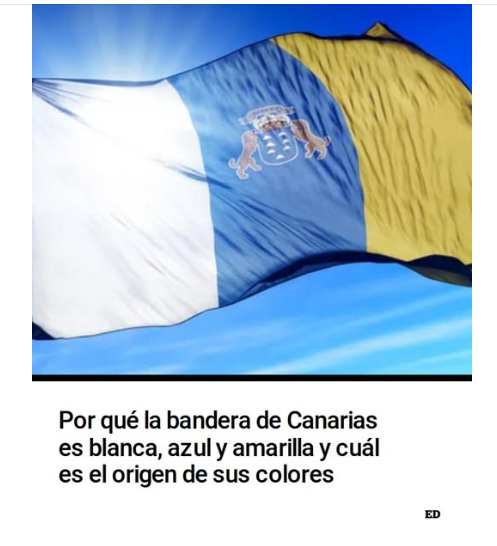
The current flag became official with the Canary Islands Statute of Autonomy in 1982.
It consists of three equal vertical bands:
• White
• Blue
• Yellow
Simple enough.
But the origins go back much further.
The Maritime Connection
The explanation most people recognise links the colours to the islands’ old maritime provinces.
Traditionally:
• Tenerife was associated with white and blue
• Gran Canaria was linked to blue and yellow
The flag essentially brought both together.
White on the left.
Blue in the middle as the shared colour.
Yellow on the right.
A sort of visual handshake between the provinces.
There Was Also an Earlier Version
Before becoming official, the white, blue and yellow tricolour had already appeared in 1961.
It was adopted by Canarias Libre, an anti-Franco movement.
The design is credited to María del Carmen Sarmiento, Jesús Cantero and Arturo Cantero, who reportedly created the first version using strips of coloured paper.
Not exactly a grand design studio moment.
Yet it stuck.
And Then Came the Seven Green Stars
Later, Antonio Cubillo, founder of the MPAIAC independence movement, created the version many people still recognise today:
The tricolour with seven green stars.
This version combined:
• The Canarias Libre flag
• The historic Ateneo de La Laguna flag featuring seven stars
It isn’t the official flag of the autonomous community.
But you’ll still see it regularly:
• Demonstrations
• Cultural events
• Stadiums
• Festivals
• Nationalist gatherings
For many people it represents cultural identity as much as politics.
A Flag with More Than One Story
Officially, the Canary Islands flag remains the white, blue and yellow tricolour adopted in 1982.
Sometimes displayed with the Canary Islands coat of arms.
Sometimes plain.
But behind those three colours sits a mix of maritime history, social movements and island identity.
Not bad for a flag most people only notice when it’s hanging from a balcony during Día de Canarias.