
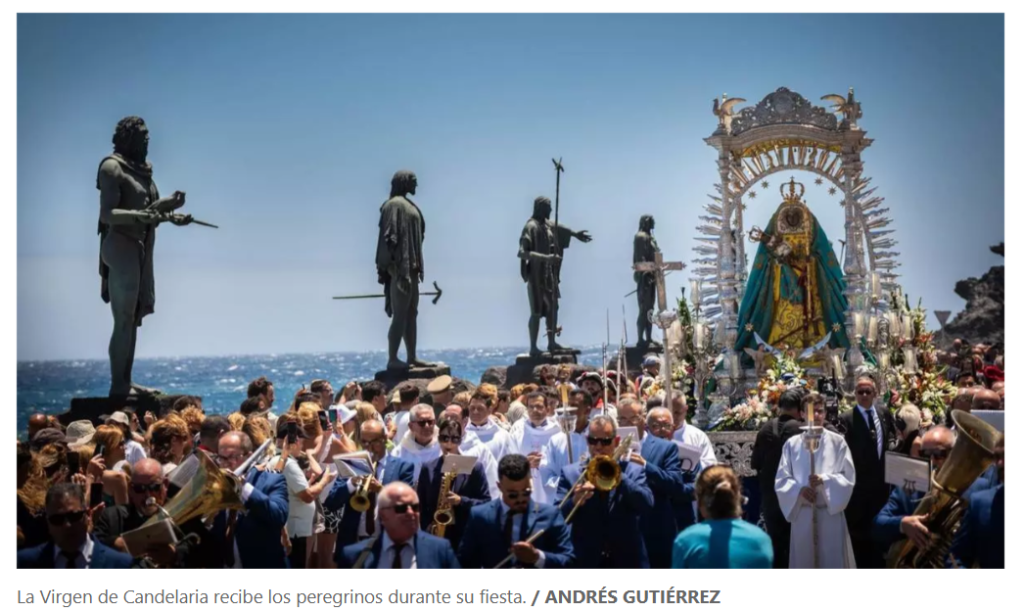
Every August, thousands of people make their way to Candelaria, many of them on foot, for one of Tenerife’s most important religious celebrations.
The biggest crowds traditionally arrive during the night of 14 August, ahead of the main celebrations on the 15th.
But there is an older story connected to this time of year.
Long before the conquest of Tenerife, the Guanches celebrated Beñesmén, a festival associated with the harvest, the arrival of summer and, according to some interpretations, the beginning of a new year.
The fact that this celebration took place in August has led some historians and researchers to draw a connection between the ancient festival and the modern celebrations surrounding the Virgin of Candelaria.
That doesn’t mean they were the same festival. The reality is rather more complicated.
What was Beñesmén?
Beñesmén, also written in historical sources as Beñesmer or Beñesmet, was one of the important celebrations of the ancient inhabitants of the Canary Islands.
The term was used to refer to the month of August as well as the festivities held during that period.
The 17th-century physician and historian Tomás Marín de Cubas wrote that the ancient Canarians called August beñasmer and celebrated major festivities during the month, involving lights, dancing and food.
The celebrations were linked to the end of the harvest. It was a time to give thanks for food, share it and come together as a community.
Some interpretations also suggest that Beñesmén marked the beginning of a new annual cycle.
There is an important caveat here, though.
Much of what we know about Guanche beliefs and traditions comes from accounts written after the conquest. So it isn’t always possible to say with certainty exactly how these ceremonies were performed or what every element meant.
The Virgin of Candelaria and the Guanches
The story of the Virgin of Candelaria in Tenerife also begins, according to tradition, before the conquest was complete.
The most well-known account tells of two Guanche shepherds who discovered a female figure on the coast of Güímar, at what is now Chimisay beach.
The figure was carrying a child in one arm and a candle in the other.
After a series of events considered extraordinary, the image was taken to the cave of Achbinico, now known as the cave of San Blas in Candelaria.
Tradition places the discovery around 1400, several decades before the conquest of Tenerife was completed.
The story was later recorded by the Dominican friar Alonso de Espinosa in a work published in 1594.
According to some interpretations, the Guanches initially venerated the figure before she was identified with the Virgin Mary.
Some authors have connected her with Chaxiraxi, a name traditionally attributed to a Guanche female deity.
Following the conquest and the spread of Christianity, the devotion became incorporated into Catholic worship and the image became known as the Virgin of Candelaria.
Over time, she became one of the most important religious symbols in the Canary Islands.
So why 15 August?
There’s another interesting detail here.
The main liturgical feast of the Virgin of Candelaria is actually celebrated on 2 February.
In Tenerife, however, there is another major celebration on 15 August, coinciding with the Assumption of Mary.
It’s this August celebration that attracts the huge numbers of pilgrims and creates the scenes Candelaria is now famous for.
And that’s where the possible connection with Beñesmén becomes particularly interesting.
The ancient Guanche festival took place during August, while the modern celebration of the Virgin takes place on 15 August.
Whether there is a direct historical continuity between the two remains difficult to prove.
What we can say is that two very different traditions became associated with the same time of year, centuries apart.
So when thousands of people walk into Candelaria this August, they’re taking part in a Christian pilgrimage that sits within a much older landscape of Tenerife’s history.
The stories are different, the beliefs are different, but the month of August has been a significant time on the island for a very long time.