
Two centuries later, questions still surround the disappearance of the original image of the Canary Islands’ patron saint, swept out to sea during one of the most devastating storms in Tenerife’s history.
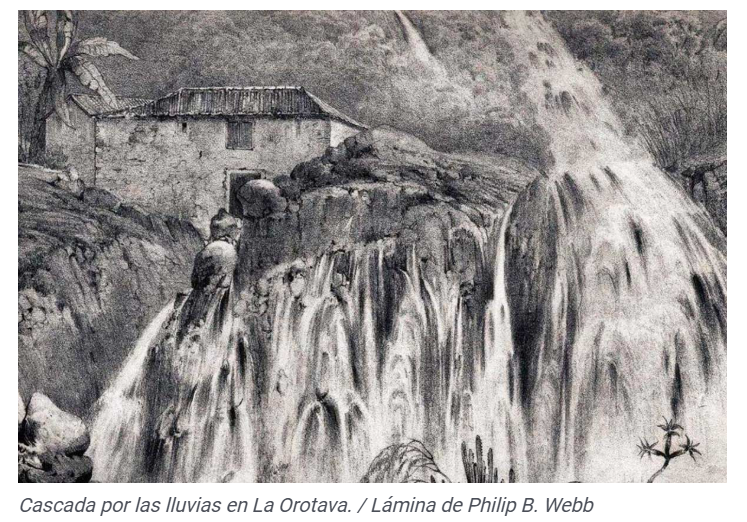
On 7 November 1826, a storm began to batter Tenerife. It would continue until the 9th, with the worst of the weather arriving during the early hours of 8 November.
The scale of the disaster was extraordinary. Torrential rain caused ravines to burst their banks, destroying homes, crops and livestock and claiming hundreds of lives. In the La Orotava Valley alone, 235 people died, while further losses were recorded in La Guancha and San Juan de la Rambla.
But the storm also left behind another mystery, one that has never entirely gone away.
During the chaos, the original image of the Virgin of Candelaria disappeared, apparently swept into the sea from the Dominican convent in Candelaria.
Or at least, that is the accepted version.
Because there has long been another possibility: that the image lost during the storm was not the original at all.
The great storm of 1826
The events of November 1826 are well documented, including in the account of British resident and merchant Alfred Diston, who witnessed the devastation from Puerto de la Cruz.
His description records the destruction caused by overflowing ravines, with entire settlements disappearing beneath water and debris. Santa Catalina was among the places effectively wiped out, while the old settlement of Higas in the La Orotava Valley also disappeared.
The storm did not only affect the north.
The sea became extraordinarily violent, with ships being driven ashore and lives lost among crews and passengers. In Candelaria, the damage was particularly severe because the coastal waves penetrated far inland.
Eight members of one family, including a military corporal, his wife and their six children, were among those who died.
The sea also reached the Dominican convent, where the revered image of the Virgin of Candelaria had been kept for centuries.
According to the account, the waves eventually entered the convent and carried the image out to sea.
It was never recovered.
The image that was lost
The disappearance of the original image was a huge blow to the people of Tenerife.
The Virgin had been associated with the island for centuries and was already a deeply established religious symbol. Her loss came on top of the deaths, destruction of homes, damage to agriculture and the loss of boats and livestock caused by the storm.
A replacement was eventually commissioned from Fernando Estévez, the multi-talented artist from La Orotava.
His new image was completed and presented in 1830, almost four years after the original disappeared.
It is the image that remains associated with the Virgin of Candelaria today.
But that did not completely settle the matter.
Was the image lost in 1826 really the original?
One of the more intriguing theories concerns Adeje and an earlier replica of the Virgin.
According to historical records, the Marquis of Adeje, as patron of the Dominican Order and the convent of Candelaria, had requested the original image centuries earlier.
The image was taken to Adeje, where a replica was made. A large painting depicting the Virgin’s appearance to the Guanches was also produced.
The important detail is the date.
This did not happen shortly before the 1826 storm, as some versions of the story suggest. Evidence indicates that the transfer took place during the second half of the 17th century.
The replica was already listed in the inventory of Santa Úrsula Church in Adeje in 1684.
This means the Adeje image had been there for roughly 140 years before the storm.
The image still kept in Adeje
The replica remains in Santa Úrsula Church in Adeje, where it occupies the central position of an historic altarpiece.
According to the research cited in the source material, the altarpiece itself dates from 1596 and was originally created for the Virgin’s image in Candelaria. It was replaced in 1681 and subsequently transferred to Adeje.
There is another fascinating detail.
In his 16th-century work Historia de Nuestra Señora de Candelaria, the Dominican friar Alonso de Espinosa described the original image in considerable detail.
He referred to its appearance, clothing, colours and the mysterious inscriptions running around parts of its garments.
The description has led some researchers to suggest that the image now kept in Adeje bears similarities to Espinosa’s description of the original, including the colour of its hair.
The present-day Candelaria image created by Fernando Estévez in 1830 has darker hair.
Why didn’t Adeje return the replica?
The mystery became even more interesting after the 1826 disaster.
While the Dominicans and others considered how to replace the lost image in Candelaria, the replica kept in Adeje was reportedly requested.
But Adeje did not send the image.
Instead, the painting depicting the Virgin’s appearance to the Guanches was sent to Candelaria. That painting remains there today.
The refusal has inevitably fuelled speculation.
If the Adeje image was simply a 17th-century replica, why was it not sent to Candelaria temporarily while a permanent replacement was prepared?
There is no definitive answer in the material presented here.
And that is where the historical mystery remains.
A tradition of disputes over the Virgin’s image
The story also sits within a much longer history of attempts to control or relocate the image.
Espinosa recorded an earlier tradition in which people associated with Sancho Herrera, Lord of the Canary Islands, supposedly took the Virgin’s image to Fuerteventura before the conquest of Tenerife, only to return it after a series of misfortunes and what were interpreted as warnings.
Centuries later, colonial authorities in Tenerife attempted to move the image to La Laguna.
The Guanche descendants associated with its custody, supported by the Dominicans, challenged the move in what became known as the Pleito de los Naturales. The resulting decision recognised the right for the image to remain in Candelaria.
Against that background, the involvement of the powerful Marquis of Adeje in the 17th century adds another layer to an already complicated story.
Could modern science finally solve the mystery?
There is one obvious question that remains.
If the image in Adeje is a 17th-century replica while the original dates back much further, could modern scientific techniques establish its approximate age?
In theory, determining the age and materials of the sculpture could provide valuable evidence.
It would not necessarily answer every question surrounding its history, but it could help establish whether the image currently preserved in Adeje is consistent with the documented 17th-century replica.
For now, the mystery remains.
The accepted historical account is that the original Virgin of Candelaria was swept into the sea during the catastrophic storm of November 1826.
But the existence of an older replica in Adeje, the circumstances surrounding its creation and the refusal to send it to Candelaria after the disaster have kept another possibility alive for generations.
Two hundred years later, the sea has never given Tenerife its answer.