
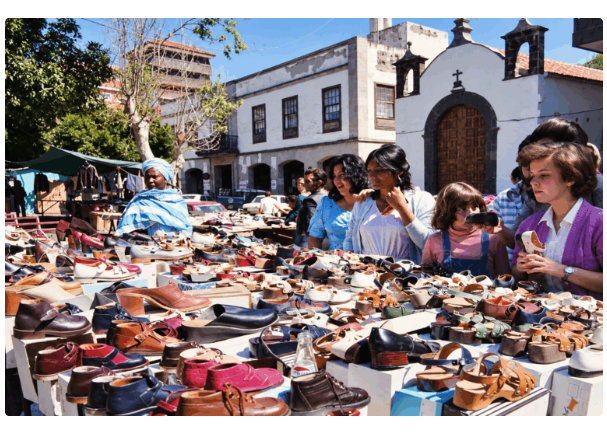
The autumn festivities in La Laguna have a long history, and few places illustrate that better than the Hermitage of San Miguel, dedicated to San Miguel Arcángel, co-patron of La Laguna.
The small historic building stands in one of the most recognisable parts of the old town. It has not been used for worship for some time and has instead served as an exhibition space. It is currently undergoing restoration.
Its architecture is attributed to Pedro de Llerena, a builder and architect from Seville.
More than a place of worship
The hermitage became important to the developing city very early on.
It wasn’t simply somewhere people went to pray. Meetings of the Cabildo were also held there, making it part of the political and administrative life of the young city.
One documented meeting took place on 22 October 1507, when councillors Sancho de Vargas, Hernando de Trujillo, Andrés Xuares Gallinato, Guillén Castellano and Alonso de las Hijas gathered at the hermitage.
Another meeting followed on 2 October 1525, when Suárez Valdés, Castellano, Trujillo, Las Casas and Requena approved a number of measures, including a prohibition on gambling in taverns.
Not exactly the sort of thing you expect to find in the history of a small religious building, but it gives an idea of how closely religion, government and everyday life were intertwined in La Laguna at the time.
The old images of San Miguel
Documents from the 16th century record two representations of San Miguel inside the hermitage.
One was a gilded three-dimensional sculpture, while the other was a painted image.
The sculpted figure was restored in 1577 by the artist Ruy Díaz, with the polychrome decoration carried out by Jerónimo de Hontiveros.
The image formed part of a collection of religious and artistic objects connected with the celebrations dedicated to the archangel.
There was also a chalice made by silversmith Antonio Ossorio, while the revered image had its own processional platform, or andas, made in Las Palmas using silver donated by Canon Muñoz.
The hermitage also had an altar frontal made from cotton and Chinese silk.
A glimpse into Tenerife’s connections
These objects were more than decoration for religious ceremonies.
They also provide a small glimpse into the commercial and cultural connections that existed between the Canary Islands and other parts of the world.
Materials such as Chinese silk, silver and other valuable objects found their way into religious buildings in Tenerife, reflecting both the importance attached to major religious celebrations and the trading networks that connected the islands with the wider world.
The Hermitage of San Miguel therefore tells a story that goes well beyond its religious purpose.
It was a place of worship, a meeting place for the Cabildo and a setting for some of the ceremonies surrounding one of La Laguna’s historic patron figures.
And with the building now undergoing restoration, another small piece of the city’s history is being preserved for the future.