Santa Cruz de Tenerife has turned into an outdoor science laboratory, with the Starmus Festival bringing experiments, robotics, space exploration and music into the heart of the city.
The eighth edition of the festival has returned to Tenerife after ten years abroad, with the aim of making science accessible to the public and encouraging younger generations to take an interest in scientific careers.
Saturday’s Starmus Science Camp featured more than 20 stands, talks from leading scientists and musical performances, giving visitors the chance to get involved rather than simply stand around looking at displays.
From Brain Science to Space Exploration
The day opened with a talk by May-Britt Moser, who won the Nobel Prize in Physiology or Medicine in 2014.
She discussed her research into the brain, memory and spatial awareness, explaining how the hippocampus helps form memories and allows the brain to build a map of its surroundings. Her work is particularly relevant to research into conditions such as Alzheimer’s disease.
The festival also welcomed astronauts, including Chris Hadfield, alongside science communicator Aneeshwar Kunchala and musician Giancarlo Erra.
Getting Children Involved
Much of the activity was designed to get children experimenting and asking questions.
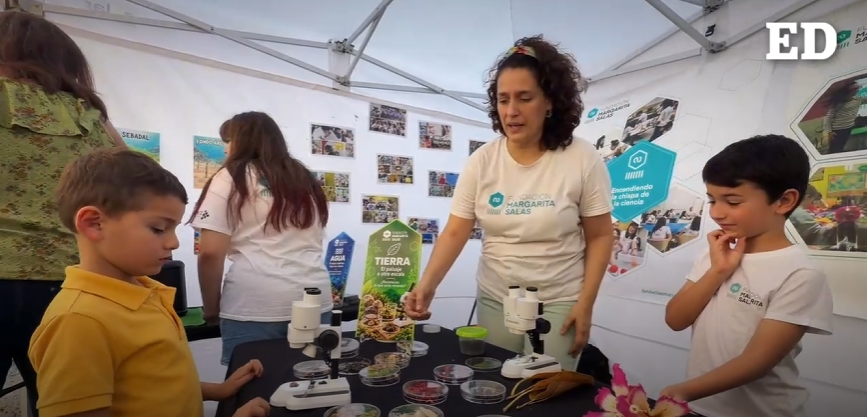
Five-year-old Thiago Molina found himself fascinated by the microscopes at the Margarita Salas Foundation stand. He had arrived with his family by chance, but quickly became absorbed in what he could see.
His father, Saulo Plasencia, explained that Thiago was at the age when he wanted to see and understand everything, with a particular interest in science, nature and geography.
Other activities gave children the chance to investigate the Canary Islands’ natural environment through practical experiments. Students led workshops themselves, sharing what they had learned with other visitors.
Ten-year-old María Ramos demonstrated an experiment exploring marine environments, including different types of seabed and the impact of rubbish pollution.
Building Satellites and Exploring Robotics
Space technology was another big attraction.
At the Hyperspace Canarias stand, visitors learned about the TeideSat nanosatellite project, which aims to study optical communications with Earth.
Nine-year-old Cristina Vázquez took part in a workshop where she built a small satellite model and launched it using a wind tube.
According to organiser Diego Cruz, children were applying Newton’s laws as they worked out how to get their models into the air, even if they weren’t necessarily thinking about the physics involved.
Robotics also featured, with the ITED research group demonstrating games designed to exercise memory, concentration and mental agility.
Computer engineering PhD student Jesús Navarro said the aim was to make robotics less intimidating and encourage people to interact with technology.
Science Camp Continues Until Tuesday
The Starmus Science Camp exhibits remain open until Tuesday, 20 October, from midday until 8pm.
The official inauguration later on Saturday included astronauts from the Artemis II mission and musical performances, including a tribute to Queen.
For Santa Cruz, it’s a chance to bring science out of lecture halls and laboratories and into public spaces, where children can get their hands dirty, ask questions and perhaps discover an interest they didn’t know they had.