
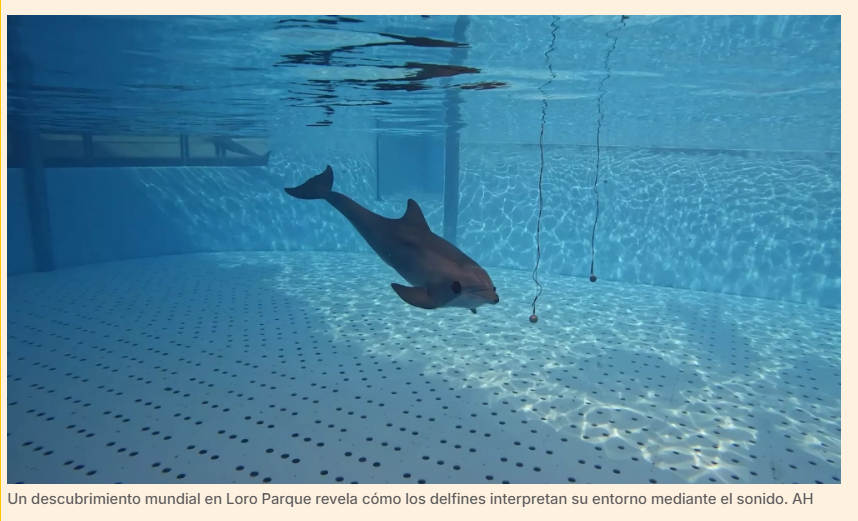
Researchers in Tenerife have discovered that bottlenose dolphins can distinguish between different materials using echolocation, even when the objects look identical
Researchers from the University of Southern Denmark and Loro Parque Fundación have uncovered new insights into how bottlenose dolphins use sound and movement to identify objects in their environment.
The study, carried out at Loro Parque in Tenerife, found that dolphins can distinguish between spheres made from materials including plastic, aluminium, brass and steel using echolocation alone.
In other words, the dolphins did not need to see the objects to tell them apart.
How dolphins ‘see’ with sound
Bottlenose dolphins produce rapid ultrasonic clicks and analyse the echoes that return after the sound hits an object.
This process allows them to build a constantly changing picture of their surroundings. Rather like having an underwater ultrasound system, although obviously one that comes with fins.
For the research, two dolphins at Loro Parque, Achille and Clara, were trained to swim towards suspended spheres and identify the one made from a particular material.
The objects were visually similar, meaning the dolphins had to rely on their acoustic perception to make the distinction.
Researchers used sensitive hydrophones and synchronised underwater cameras to record what happened during each trial. They were able to observe how the dolphins changed their head position, swimming trajectory and echolocation clicks before making their choice.
Dolphins actively adjust how they explore
One of the interesting findings was that the dolphins did not simply produce clicks and wait for the information to come back.
They actively changed their movements and sound production while investigating the objects.
According to lead scientist Sara Torres, the research showed that dolphins adjust both their movements and their clicks to investigate the composition of objects around them.
The study also compared bottlenose dolphins with common porpoises using the same experimental protocol. Both species displayed active exploratory behaviour, including changes in head position and swimming paths, although differences in their sound frequencies and structures affected their ability to discriminate between materials.
Why the research matters for conservation
Understanding how cetaceans interpret their acoustic surroundings could have implications well beyond the laboratory.
The oceans are becoming increasingly noisy because of human activity, and underwater noise can interfere with animals that depend heavily on sound to find food, navigate and communicate.
A better understanding of how different species use echolocation could therefore help researchers assess how changes in the underwater acoustic environment affect wild cetacean populations.
It could also contribute to more targeted conservation measures based on the particular biology of each species.
Research carried out at Loro Parque
The researchers said the study benefited from the environment at Loro Parque, where Achille and Clara participated voluntarily in the experimental sessions following years of positive training.
The facility’s veterinary team, specialist staff and research facilities provided the conditions required to collect detailed acoustic and behavioural data.
Loro Parque President Wolfgang Kiessling said the research reinforced the organisation’s commitment to science, animal welfare and biodiversity protection, while highlighting the importance of collaboration between researchers and specialist teams.
The findings have been published in The Journal of the Acoustical Society of America (JASA), an international journal specialising in acoustics.
The research was supported by the Office of Naval Research, the Human Frontiers Science Program and the Carlsberg Foundation.
It is a useful reminder that there is still a huge amount we don’t know about what is happening beneath the surface. Dolphins, meanwhile, have apparently been getting on with it for quite some time.