
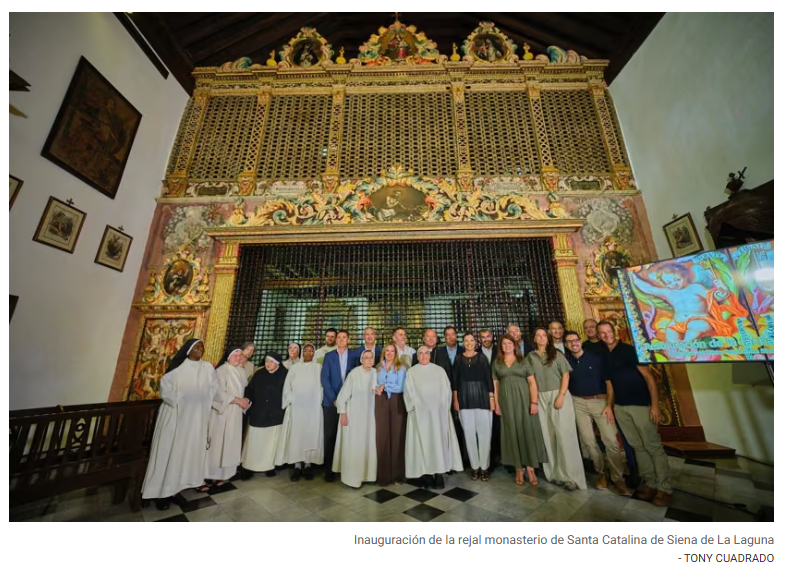
A piece of La Laguna’s history has been given a new lease of life following the completion of restoration work on the historic choir screen at the Monastery of Santa Catalina de Siena.
Tenerife’s Cabildo has officially unveiled the restored piece following an investment of €70,000, with the work focused on preserving an important example of the island’s artistic and cultural heritage.
The ceremony was attended by Cabildo President Rosa Dávila, Bishop Eloy Santiago of the Nivariense Diocese, local officials and members of the religious community, including Sor María Cleofé López and Sor Montserrat Román.
Preserving a piece of La Laguna’s history
Dávila described the restoration as much more than simply repairing an old structure.
For her, the project represents the recovery of part of La Laguna’s history and cultural identity, helping to ensure that an important piece of the community’s collective memory remains for future generations.
The choir screen, made up of both high and low sections, is located inside the church of the monastery. The building was officially recognised as a Cultural Heritage asset in 2013.
Historical documentation has described the choir screen as a “total work of art”, underlining the importance of its artistic character.
Restoration rather than replacement
The work presented its fair share of challenges.
Isabel de Esteban, Director of Territorial Planning, explained that the priority was to preserve as much of the original work as possible while carrying out the repairs necessary to ensure its long-term survival.
That meant restoring the piece without turning it into something that looked brand new.
The approach was based on detailed studies of the original materials and decorative elements. Among the work carried out was the recovery of lost support and paint.
As de Esteban pointed out, restoration is about understanding and respecting the history of an object rather than simply making it look new.
An important artistic connection
The decorative elements of the choir screen are attributed to Cristóbal Hernández Quintana, an important figure in Canary Islands painting.
That connection adds another layer of historical and artistic significance to the piece and helps explain why its careful conservation matters.
Miguel Ángel Clavijo, Director of Cultural and Heritage Affairs, also highlighted the collaborative nature of the project, stressing that preserving cultural heritage is a shared responsibility.
For Fran Hernández, La Laguna’s Deputy Mayor, projects like this help maintain the history and identity of the local community.
Cultural Heritage councillor Adolfo Cordobés similarly highlighted the value of the convent, not simply as an old building, but as a place with a deep connection to the feelings and memories of local people.
The restoration has now been completed in accordance with strict conservation guidelines, ensuring that this part of La Laguna’s history can continue to be seen and appreciated for years to come.