
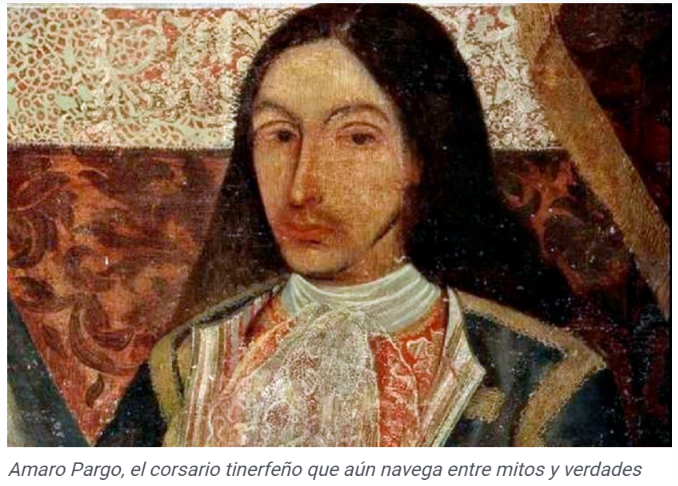
Treasure, piracy, forbidden romances and a mysterious fortune hidden somewhere in Tenerife. Few historical figures from the Canary Islands have attracted quite as many stories as Amaro Rodríguez Felipe, better known as Amaro Pargo.
Born in La Laguna in 1678, Amaro Pargo became one of the most influential corsairs operating in the Atlantic during the 18th century. His reputation has grown over the years, fuelled by stories of hidden treasure and romantic intrigue. Even video game company Ubisoft became interested in his story, going as far as exhuming his remains from the Convent of Santo Domingo de Guzmán in La Laguna to investigate his past.
But how much of the story is actually true?
Three historians, Manuel de Paz Sánchez, Daniel García Pulido and Francisco Braian Cabrera Alonso, have spent years examining the documentary evidence. Their latest book, Amaro Pargo. Todo lo que sabemos sobre el corsario, brings together much of that research in a more accessible 150-page publication.
The aim is to separate historical fact from the rather more colourful stories that have built up around him.
Corsair, not pirate
One of the first things the historians want to clear up is the difference between a corsair and a pirate.
Although Amaro Pargo is often described as a pirate, he was actually a corsair. The distinction was important. Corsairs operated with official authorisation from the authorities, allowing them to attack enemy ships and defend the interests of the Spanish Crown.
Pirates, on the other hand, operated outside the law and could face execution if captured.
For the unfortunate crews whose ships were boarded and plundered, the distinction probably offered little comfort. But for European governments, privateers were a useful part of their military and commercial strategy.
Canarian corsairs played a particularly important role in defending Spanish interests in the Atlantic. More than 20 operated from the islands, and their activities became increasingly offensive during the first half of the 18th century.
Historian Manuel de Paz argues that the strategic role of the Canary Islands, and the contribution of figures such as Amaro Pargo, were essential to maintaining Spain’s overseas empire.
The mystery of the missing treasure
Amaro Pargo made a considerable fortune through his corsair activities aboard ships such as El Bravo, but also through investments in vineyards, Malvasía wine and wheat.
Naturally, a wealthy corsair with a colourful reputation was always going to attract stories about buried treasure.
One popular legend claims that he hid a fortune somewhere in Tenerife. Searches were even carried out around the grounds of his former property in Machado, in the municipality of El Rosario.
Nothing was found.
De Paz is fairly dismissive of the treasure story, explaining that Pargo’s wealth had a much more ordinary destination. He supported the Church, covered his personal expenses and provided for his family, leaving his descendants with a substantial inheritance.
He also used his money to help poor people, prisoners and abandoned children, reflecting the strong religious beliefs he inherited from his family.
The romance that never happened?
Another familiar story links Amaro Pargo romantically with Sor María de Jesús, better known as La Siervita.
According to the legend, the corsair and the nun shared a secret romance. It’s a good story, admittedly, but the historians are having none of it.
Manuel de Paz describes the claim as complete nonsense and says the book provides documentary evidence challenging the tale.
Among the material examined is a historical account by Dámaso de Quesada y Chaves, dating from around 1770 and held in the library of the Spanish National Church of Santiago and Montserrat in Rome.
The research has also taken the historians through archives in Venezuela, Cuba, Portugal and Cádiz.
A hero with a darker side
It’s tempting to turn a wealthy corsair who supported the poor and served the Spanish Crown into a local hero. But the researchers are keen to avoid presenting a sanitised version of his life.
As they put it, nobody is entirely good. Their description of Amaro Pargo as both a hero and a criminal reflects that complexity.
He had lovers and children whom he never formally recognised, both in the Canary Islands and in the Americas. The researchers identify one child in Cuba and another in Tenerife, with the possible existence of a third still uncertain.
His connection with slavery is another uncomfortable part of the story.
According to the historians, Pargo owned around ten enslaved people. That was not considered a particularly high number compared with other wealthy property owners of the period, but the researchers are clear that this does not make it any less significant.
Slavery was widespread in that society, although it was not without its critics. Even at the time, there were people speaking out against it, including José de Viera y Clavijo, who described slavery as a tyranny and a disgrace to humanity.
There is still more to discover
The new book, published by La Laguna Town Hall and the Centro de la Cultura Popular Canaria, brings together 20 questions and reflections covering the main episodes of Amaro Pargo’s life.
Despite years of research, the historians say there is still plenty left to uncover, particularly concerning his time in the Americas.
Francisco Braian Cabrera Alonso is working on a doctoral thesis focusing on Pargo’s relationship with the Company of Honduras, which could shed further light on this period.
Documents once thought to have been lost have also started appearing in different archives, including the Archivo General de Indias. Their discovery has opened up new lines of investigation, although plenty of material remains to be examined.
So perhaps the treasure isn’t buried somewhere in Tenerife after all. The real prize may be hidden in the archives, waiting for someone to find it.