
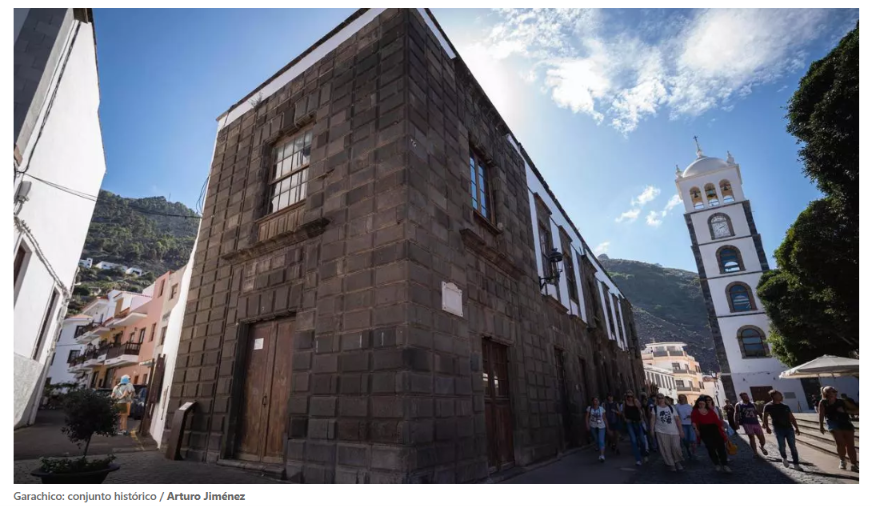
Garachico could finally be moving towards a dedicated urban protection plan for its historic centre, with the local council hoping to approve the document by early 2027.
It’s something that has been discussed for decades, and there is a good reason for the delay to matter. Garachico isn’t just another pretty Canarian town. Its streets, buildings and historic layout tell the story of one of Tenerife’s most important settlements.
The Canary Islands Government declared the historic centre a Site of Cultural Interest (BIC) in 1994. That designation requires a special protection plan setting out what can be preserved, restored or changed.
Around 1,700 people live within the historic area, which also attracts a steady stream of visitors.
A town with a remarkable past
Historian Cirilo Velázquez Ramos points out that by the end of the 17th century, Garachico had two parish churches, a hospital, a castle, five convents, several hermitages and a collection of impressive mansions.
It was also an important centre for religious art, with the renowned 17th-century artist Martín de Andújar among those associated with the town.
The historic centre is divided into four urban areas. The oldest dates from the 16th and 17th centuries and stretches from the Ermita de San Roque to the Castle of San Miguel and the Puerta de Tierra.
This is where much of Garachico’s traditional Canarian architecture can be found, covering everything from family homes and religious buildings to agricultural and military structures.
Buildings that tell the story of Garachico
Among the most recognisable properties is the Casa de Piedra, once the residence of the Marquis of Adeje. Its impressive stone façade remains a feature of the town, although the building was partly destroyed during the volcanic eruption of 1706.
The former residence of the Marquis of Quinta Roja now operates as a rural hotel.
Further west, the Lamero and La Quinta estates provide examples of traditional agricultural architecture, although their current state of preservation varies.
The Castle of San Miguel is Garachico’s only military building and was the first fortification protecting the old port. It received BIC status in 1993 and stands close to the Puerta de Tierra, built in 1602.
Nearby, the 17th-century winery of San Juan Degollado is still waiting for restoration.
Churches and convents form part of the town’s identity
Garachico’s religious architecture is another important part of its heritage.
The Church of Santa Ana dominates the skyline, with its tower reaching almost 41 metres. Construction began in 1520, although the building has been reconstructed several times. Its present form was completed between 1714 and 1721.
Next door is the Church of Our Lady of the Angels, part of the former San Francisco convent, founded in 1524. The complex has been restored and is also protected as a Site of Cultural Interest.
The Church of San Sebastián, built by the Dominican Order in 1601, is another distinctive building. Its façade features seven Portuguese-style balconies, and it now serves as a municipal care home.
The Convent of the Conceptionists, active since 1637 and restored in 1980, adds another important chapter to Garachico’s religious and architectural history.
Modern sculptures around the town also reflect how its cultural identity has continued to evolve.
Protecting more than just old buildings
Historian Cirilo Velázquez Ramos has repeatedly highlighted the need for a proper protection plan, recalling descriptions of Garachico’s historic buildings as once rivaling structures in places such as Gibraltar and Oxford.
The proposed plan is about more than preserving individual façades. It needs to protect the character and layout of the historic centre while allowing the town to continue functioning as a living community.
With approval targeted for early 2027, Garachico may finally be getting the planning framework its historic importance deserves.