
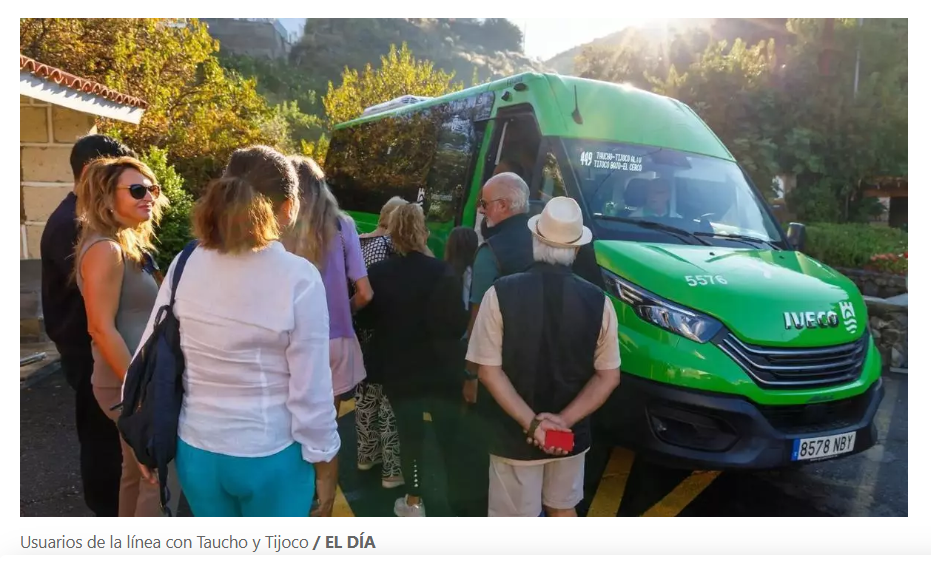
Adeje’s new urban bus service has only been running for a few weeks, but discussions are already underway about how to improve it.
The service launched on 17 August with routes 448 and 449, connecting Adeje town with La Caleta and providing a circular route through higher areas, including Los Menores and Tijoco Alto.
Early passenger numbers were reportedly strong, suggesting that residents are keen to have more local transport options and rely a little less on their cars.
Although, as anyone who has tried parking around Adeje will tell you, fewer cars would probably be welcome.
Calls for Timetable and Route Changes
Coalición Canaria (CC) is now calling for adjustments based on feedback from passengers.
Its representative, Alberto Melián, has proposed reviewing timetables and expanding coverage in La Caleta, particularly to better serve workers in the busy tourist area.
The current service operates daily between Adeje and La Caleta, while routes through the surrounding higher areas run on weekdays.
This arrangement is designed to serve two different needs: connecting La Caleta’s tourism and business activity with the rest of the municipality, while also linking more remote neighbourhoods with essential services.
Possible Extensions to Callao Salvaje and Roque del Conde
CC has also suggested gradually extending the service to Callao Salvaje and Roque del Conde.
The proposals follow requests from residents in El Puertito, Playa Paraíso and other areas who would like better public transport connections.
These extensions have not yet been approved. Authorities are continuing to collect information about daily passenger numbers before deciding how the network might develop.
That is probably the sensible approach. There is little point adding routes if the timetable does not work for residents or the service becomes too expensive to operate.
A Service Designed for a Spread-Out Municipality
Patricia León, Coalición Canaria’s candidate for mayor, welcomed the introduction of urban transport in Adeje.
She highlighted the municipality’s dispersed communities and the need for a service that connects different neighbourhoods.
León also pointed out that legislation requires municipalities with more than 50,000 residents to provide urban transport.
With that system now in place, the focus is shifting towards improving how it operates and ensuring it meets changing demand.
Melián also called for ongoing adjustments based on passenger use, while stressing the importance of keeping the service financially and operationally sustainable.
What Happens Next?
After the first month of operation, the discussion is moving beyond simply having an urban bus network in place.
The next questions concern timetable changes, additional stops and whether new routes should be introduced to serve more communities.
For residents, the success of the service will probably come down to fairly basic things: whether buses run when they are needed, whether they reach the right places and whether people can use them without having to plan their entire day around a timetable.
Adeje now has the foundations of an urban transport system. The next job is making sure it works properly for the people who live and work there.