
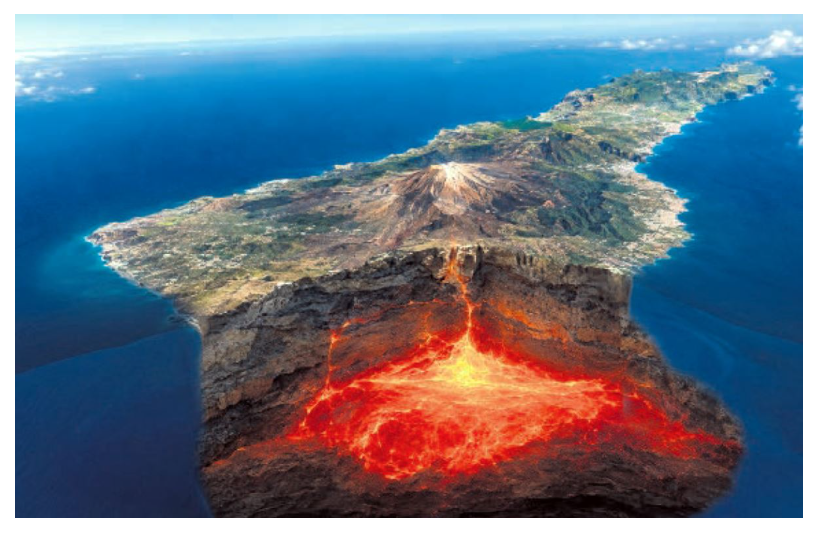
The finding could correspond to the anomalous seismic activity detected beneath the island since 2016
A study led by the Volcanological Institute of the Canary Islands (Involcan) has identified an area where a large amount of magma may be accumulating beneath Tenerife, potentially corresponding to the anomalous seismic activity detected since 2016.
The findings, published in Scientific Reports, part of the Nature group, suggest a possible connection between processes taking place tens of kilometres below the surface and phenomena that can be observed at the surface, including seismic activity and gas emissions.
For the first time, researchers have produced a three-dimensional image of the deep structure of the crust and upper mantle beneath Tenerife. The study reveals several areas of low seismic velocity that could be associated with magma accumulating at the base of the island’s ancient oceanic crust, according to Involcan.
Tenerife is home to one of the most complex volcanic systems in the Canary Islands. At the centre of the island is the Teide-Pico Viejo volcanic complex, where the three volcanic ridges converge.
Previous studies have already suggested the existence of a complex magmatic system, with different levels of magma storage extending from the upper crust down into the mantle.
The reconstruction of Tenerife’s deep structure was made possible through the analysis of more than 785 teleseismic earthquakes, meaning large earthquakes occurring in different parts of the world. These earthquakes were recorded by the Canary Islands Seismic Network in Tenerife between 2017 and 2024.
Mapping the structure beneath Tenerife
The researchers used a technique known as receiver functions, which analyses how seismic waves are transformed as they pass through discontinuities and materials with different physical properties inside the Earth.
This information allows scientists to reconstruct the structure of the subsurface and identify changes in the speed at which seismic waves travel at different depths.
One of the study’s main findings, according to Involcan, is the identification of a relatively rigid layer of oceanic crust approximately 10 kilometres thick, characterised by relatively high seismic-wave velocities.
Below this layer, however, the structure becomes much more heterogeneous. Researchers identified four major low-seismic-velocity anomalies, distributed across different areas of Tenerife and extending approximately between 10 and 30 kilometres beneath the surface.
A magma-rich area beneath western Tenerife
The most significant result is located beneath western Tenerife, where researchers identified exceptionally low velocities for S-waves.
When these results are combined with thermodynamic modelling, the findings indicate that this anomaly could contain a significant proportion of molten material, in other words, magma.
The relationship between the lowest seismic velocities and the highest proportions of molten material points towards the existence of an area in the upper mantle that is particularly rich in magma.
The study also identifies a spatial relationship between these deep low-velocity anomalies and the seismic activity recorded in Tenerife in recent years.
A significant proportion of the earthquakes located during this period are concentrated either above or around the edges of the main low-velocity anomaly.
According to the researchers, this distribution could be related to the accumulation and movement of magma within this deep region.
Could this explain Tenerife’s seismic activity?
As magma rises from the upper mantle towards shallower levels, the pressure decreases. This encourages dissolved gases within the magma to come out of solution.
At these depths, these volatile compounds consist mainly of carbon dioxide (CO₂), Involcan explains.
The subsequent movement of these gases and magmatic fluids towards shallower levels, where they interact with Tenerife’s hydrothermal system, could help explain part of the seismic activity observed on the island.
This may include the hybrid and low-frequency seismic events that have been recorded in Tenerife.
The findings therefore provide a possible link between processes occurring deep beneath the island and the seismic and volcanic-related signals being detected closer to the surface.
An international research project
The research was led by Víctor Ortega Ramos, an Involcan researcher and doctoral student at the Complutense University of Madrid.
The study is the result of collaboration between Involcan and the Complutense University of Madrid, the Institute of Technology and Renewable Energies (ITER), the Université de Genève in Switzerland, and the Institute of Volcanology and Risk Assessment (Portugal).
The research provides a new picture of what is happening beneath Tenerife, particularly in the region between 10 and 30 kilometres deep, where the identified low-velocity structures may indicate areas of significant magma accumulation.
Click here to read the original article.