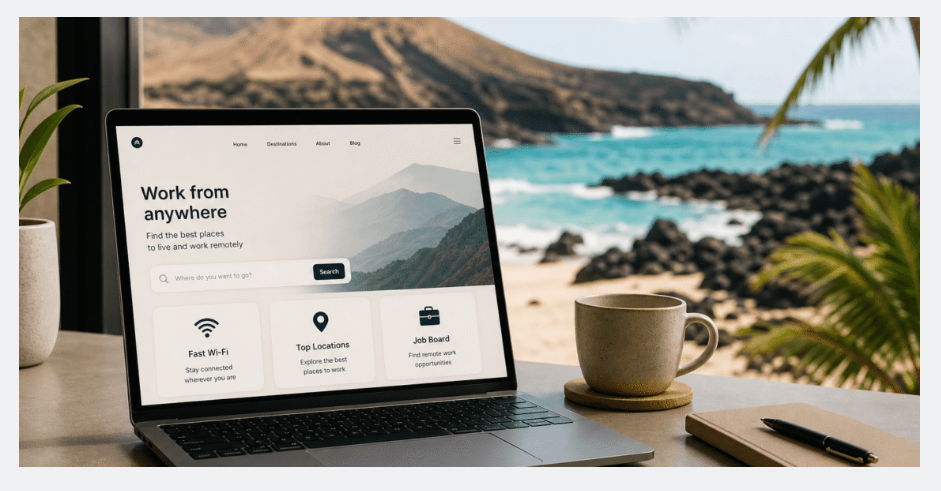
If you’re planning to work remotely from Tenerife, or you’re already here and have realised that “I’ll figure out the work side later” was perhaps a little optimistic, this is the list you actually need.
Not the usual recycled list of five freelance websites with no explanation.
These are the platforms worth knowing, what they’re good for, and where I think they’re most useful if you’re sitting in Tenerife looking for work.
First, decide what sort of remote worker you are
This matters more than people think.
There’s a big difference between wanting a stable remote salary from a company that doesn’t care where you work and wanting to freelance project by project while building your own client base.
Both can work from Tenerife.
They just require completely different approaches.
If you want a permanent job, you need to find companies that are already comfortable with remote employees. If you’re freelancing, you need somewhere to find clients and prove that you’re worth hiring.
Trying to do everything at once usually results in spending hours setting up profiles and very little time actually earning money.
The websites I’d start with
We Work Remotely
We Work Remotely would be my first stop if I were starting from scratch.
It’s not particularly flashy, but it lists genuine remote jobs from companies that have already decided remote working is how they operate.
That makes a big difference.
You’re not trying to persuade an employer that Tenerife is a reasonable place to work from. They’ve already answered that question.
There are plenty of roles in tech, design and marketing, along with other areas.
Dynamite Jobs
Dynamite Jobs is one I think deserves considerably more attention.
It’s built specifically around location-independent work, so the companies advertising there already understand the idea of hiring somebody who might be sitting in Tenerife rather than Manchester or San Francisco.
I’ve used it for several years and it hasn’t disappointed me.
The listings tend to be better curated than the big general job boards and there’s less of the usual nonsense where a job is advertised as “remote” only to reveal that you need to live within 30 miles of an office.
Remote.co
Remote.co is another one worth bookmarking.
It does a decent job of curating remote positions and breaks them down by category, which makes finding relevant roles considerably easier.
If you know what sort of work you want but aren’t quite sure what job title to search for, this can be particularly useful.
Indeed
Indeed is the obvious one, but don’t dismiss it.
The problem is that searching for “remote jobs” can produce a mountain of rubbish.
Be more specific.
Search for “remote” plus your actual job title, then use the filters to narrow things down.
It also has another useful advantage. You can use it to get a feel for what companies are actually paying for particular remote roles.
The specialist remote boards aren’t always brilliant for salary comparisons.
FlexJobs
FlexJobs charges a subscription, which immediately puts some people off.
I understand that.
But the advantage is that the listings tend to be cleaner and more carefully screened than what you’ll find on many free job boards.
It’s particularly useful if you’re looking for part-time, flexible or remote employment rather than just another standard nine-to-five.
If you want to freelance
Upwork
Upwork is the obvious starting point, and yes, it still works.
The mistake is thinking you need to apply for hundreds of jobs to get noticed.
You don’t.
Pick a specific service. Build a decent profile around that service. Price yourself sensibly and look for clients who have the potential to become long-term customers.
One good client paying you every month is worth considerably more than ten jobs that pay peanuts and disappear afterwards.
PeoplePerHour
PeoplePerHour is particularly interesting if you’re targeting British clients.
That’s quite useful from Tenerife because you’re working in roughly the same time zone.
If you’re selling your services to UK businesses, that’s worth mentioning.
You’re not waking up at 3am to join a Zoom call with somebody in California.
Fiverr
Fiverr has changed quite a bit over the years.
The old image of everything costing five dollars isn’t really accurate anymore.
It works particularly well if you have a service that can be packaged clearly. Writing, design, translation, video editing, voiceover and similar services can all work.
It’s less useful for complicated consultancy work where the client really needs to speak to you before deciding what they actually want.
LinkedIn isn’t technically a freelance platform, but I’d still put it on the list.
A decent profile that clearly explains what you do, who you help and that you’re available for remote work can bring enquiries directly to you.
It takes longer than signing up to a marketplace.
The upside is that you’re building an asset rather than constantly competing for the next job.
A few others worth knowing
Remotive
Remotive collects remote vacancies and sends them out through its newsletter.
It sounds simple because it is.
That’s actually the point.
Good opportunities arriving in your inbox saves you constantly searching through job boards.
Working Nomads
Working Nomads is particularly useful if you’re actually location-independent.
That’s important because “remote” doesn’t necessarily mean “work from anywhere”.
Some companies mean remote within Spain.
Others mean remote within the US.
Others want you to be within commuting distance of their office, which rather defeats the point.
Working Nomads is better at separating genuinely location-independent roles from the rest.
Toptal
Toptal is worth knowing about if you’re already highly experienced in software development, design or finance.
The vetting process is tough and it isn’t somewhere I’d send a beginner.
But if you have the experience and get through the process, the clients and rates can be very good.
The Tenerife bit nobody tells you
The internet is generally good across Tenerife.
Generally.
That doesn’t mean everywhere is equally reliable.
If you’re moving into a rural or mountainous part of the island, test the connection properly before signing a long-term rental.
And don’t do the speed test at 11pm when nobody else is online.
Do it at 9am on a weekday.
That’s when you’ll find out what your connection is really like.
Then there’s the other problem.
The weather.
Yes, I know. Poor me.
But when you’re working from home and it’s a beautiful February afternoon outside, the Atlantic is sitting there and the sun is shining, staying at your desk can require a surprising amount of discipline.
Working early mornings can help.
Get five or six solid hours done and you’ve still got a large chunk of the afternoon left.
That’s a pretty good arrangement if you can make it work.
Don’t forget the visa situation
If you’re planning to live in Tenerife long term while working remotely, look properly into Spain’s digital nomad visa and the rules that apply to your particular circumstances.
Don’t base your decision on something you read in a Facebook group from somebody who moved here three years ago.
Rules change.
Your circumstances might also be different from theirs.
If you’re going to make a major life decision around it, get the current information and make sure it applies to you.
So where should you start?
If you’re looking for a stable remote job, I’d start with:
- We Work Remotely
- Dynamite Jobs
- Remote.co
- Indeed
- FlexJobs
If you’re going freelance, I’d look at:
- Upwork
- PeoplePerHour
- Fiverr
You don’t need to be everywhere.
In fact, I’d suggest the opposite.
Pick two platforms and do them properly rather than creating six profiles that you never update.
And here’s the bit people don’t particularly like hearing.
Some of the best remote work I’ve seen people get while living in Tenerife didn’t come from a job board at all.
It came from doing good work for somebody, building a relationship and eventually having the conversation about working remotely.
That’s slower.
But it’s also a lot less competitive than trying to beat 400 other applicants to the same job on Upwork.
The remote work is out there.
The platforms are real.
And the lifestyle people imagine when they think about working from Tenerife can absolutely be done.
But it still involves work.
Unfortunately, Tenerife hasn’t yet developed a system where your laptop earns money while you’re sitting on the beach. I’ve checked.