
Every year Adeje puts a lot of effort into Semana Santa. Some years it’s bigger than others, but you can see the council really wants it to become one of the main religious and cultural events on the island.
This year they’ve brought in a fairly well known name.
The Easter proclamation speaker for Adeje’s Semana Santa will be the writer and presenter Christian Gálvez. He’ll also be presenting his new novel while he’s here. The event takes place on Saturday 21st March at 7pm in the Church of Santa Úrsula.
If you’ve spent any time around Adeje during Easter you’ll know it’s not just a religious programme. It’s also become quite a social event for the town.
According to the mayor, José Miguel Rodríguez Fraga, the whole idea is to bring people together. Over the years the celebration has grown into something that mixes faith, culture and community. Locals, visitors and the different neighbourhoods all get involved.
The programme actually started earlier this month with the IV Vía Crucis del Pueblo on the 9th of March.
From the 21st March onwards things start to pick up properly. There will be a cycle of talks called “History, Science and Mysteries of Christianity”, several themed exhibitions, and of course the well known “Pasión de Adeje” theatrical performance on the 3rd of April.
Those talks will take place in the Espacio de Historia y Arte El Barranco and are organised by José Gregorio González Gutiérrez. Alongside the talks there will be two exhibitions, one about Marian apparitions and another about the different historical representations of Jesus.
There will also be an exhibition of the Semana Santa religious statues in the Adeje convent, with panels explaining each of the figures.
Before all of that, there’s a sacred music concert on the 14th March at the San José parish in Los Olivos.
The main religious celebrations begin between the 28th of March and the 5th of April. That includes Palm Sunday events, the Triduo of Our Lady of the Incarnation, the Santo Encuentro, the Mandato, the Holy Burial procession, the Silent Procession, the Easter Vigil and Easter Sunday masses.
One of the biggest moments will again be the Pasión de Adeje on Friday the 3rd of April. It begins with a procession and then moves into a theatrical performance along Calle Grande. It’s also broadcast on television and online which has helped it reach a much wider audience over the last few years.
Something new this year will happen after the Easter Sunday mass on the 5th of April at 11am.
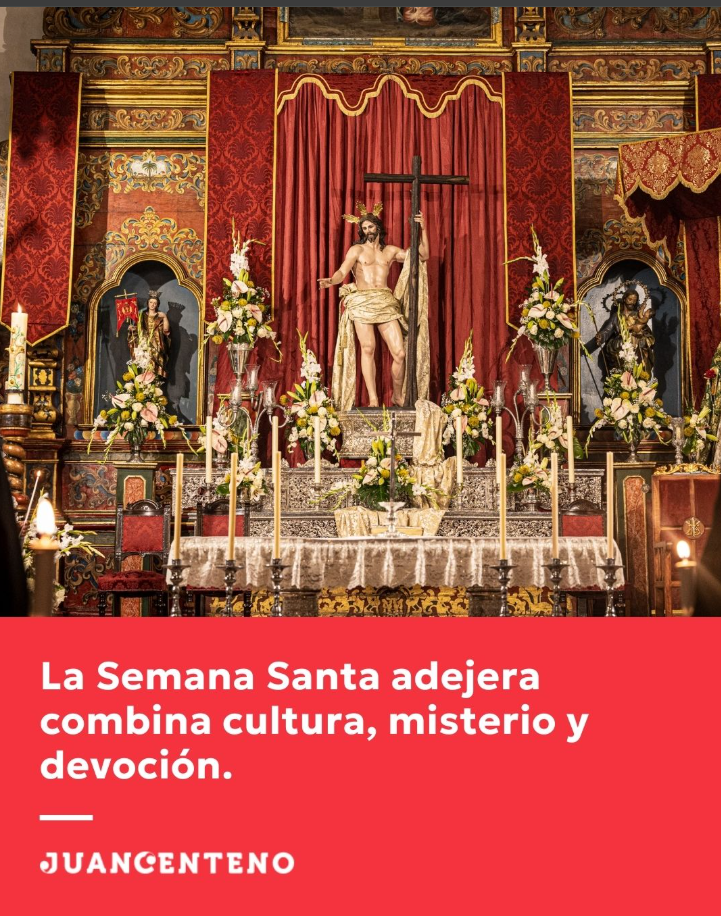
For the first time there will be a procession of a new statue of the Risen Christ. The sculpture is life size, carved in cedar wood and finished in oil polychrome. It was created by the Cordoban sculptor José Antonio Cabello and now becomes part of Adeje’s religious heritage.
The procession will be accompanied by the Adeje Municipal Band and will run from the Church of Santa Úrsula to the Plaza de la Cruz del Llano before returning to the church.
One practical note this year.
Some of the procession routes have been changed due to the works currently taking place on Avenida Constitución. Anyone planning to attend should check the municipal website for updated routes and times.
The final event of the programme will be the Rogativa and the closing of the lustral year on the 19th of April, with a procession from Santa Úrsula to the Church of San Sebastián.
A long history behind it all
Semana Santa in Adeje isn’t something new. It’s actually documented as far back as 1561.
Over the centuries the town has built up quite an impressive collection of religious sculptures which are now considered an important part of its historical and artistic heritage.
One of the most notable pieces is La Piedad in the Santa Úrsula parish, created by the Sevillian sculptor Juan Ventura and incorporated in the early 2000s.
In Tijoco La Hoya you’ll find La Dolorosa, sculpted by Tenerife artist Ezequiel de León in the 1980s.
Other well known pieces include the Cristo de la Buena Muerte from the Belloso workshops, the Cristo de la Burrita by Juan Abascal, and the Oración del Señor en el Huerto, a late 19th century piece from the Levantine school.
As the week continues there are processions featuring figures such as Nuestro Padre Señor Cautivo, Nuestra Señora de la Esperanza, the Cristo de las Penas by Francisco Romero Zafra, and the Cristo Nazareno.
By the time Good Friday arrives the focus turns to the Cristo Yacente during the Santo Entierro procession, accompanied by the Magdalena and the Santos Varones.
The day finishes with the procession of the Virgen de los Dolores.
If you enjoy local tradition, or just want to see something that still means a lot to the people who actually live here, Semana Santa in Adeje is worth seeing at least once.
If you’d like to read the original article, click here.