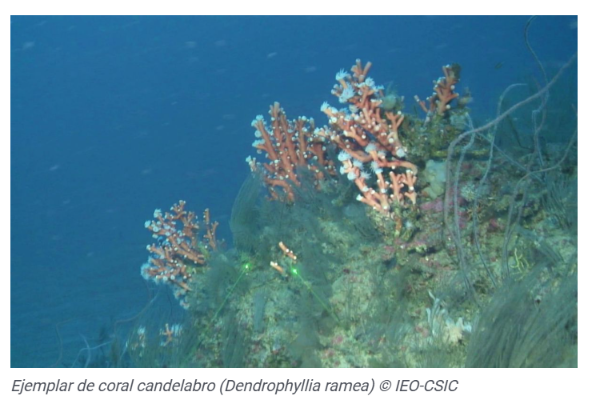
Scientists have found a population of candelabrum coral off the south-east coast of Tenerife with the highest density ever recorded in the Atlantic Ocean.
The team from the Spanish Institute of Oceanography (IEO-CSIC) identified 190 colonies at a depth of around 100 metres, some of them almost 70 centimetres across.
The findings have been published in the scientific journal Regional Studies in Marine Science.
How was it found?
During the DEEP CANARIES expedition, which ran in February and March 2025 aboard the research vessel Ángeles Alvariño.
To explore the seabed, the researchers used the Liropus 2000, a remotely operated underwater vehicle fitted with high-resolution cameras.
The footage revealed 190 colonies along a stretch of seabed of about 1.8 kilometres, at depths of between 92 and 108 metres. Most were growing on rocky ground.
What makes it so special?
Two things: how many there are, and how big they are.
In the densest spots, the researchers counted up to 9.3 colonies per square metre, more than has ever been recorded for this species in the Atlantic.
The corals were big, too. 58% of those measured were more than 20 centimetres wide, and some reached 68.5 centimetres. That’s comparable to the largest recorded in parts of the Mediterranean, where the species has been studied much more.
Silvia Oliva, a researcher at the IEO-CSIC and lead author of the study, said it isn’t just the density that makes the find exceptional, but the size of the colonies too. Together they point to a well-developed population of real ecological interest.
Why does candelabrum coral matter?
Candelabrum coral (Dendrophyllia ramea) is a stony coral that forms large branching structures on the seabed. These create shelter for lots of other marine life and add to the variety of underwater habitats.
It’s considered an indicator of vulnerable marine ecosystems under criteria set by the UN Food and Agriculture Organization (FAO). The reef habitats it lives in are also recognised as being of community interest in the EU.
The coral was already known to live around the Canary Islands, but there was very little detailed data on how many there are, where they are or how big they grow. This study helps fill that gap.
Is it under threat?
The footage shows large colonies, sometimes surrounded by plenty of fish. But it also shows bits of discarded fishing gear, a sign of human activity down there.
The researchers also point out that the coral is less than two kilometres from areas earmarked in marine planning for possible offshore wind farms. They warn that such developments could directly disturb the habitat, or shift other activities like fishing.
To be clear, the study doesn’t say wind farms are damaging the coral now. Its argument is about prevention: there needs to be enough scientific information before any new activity is approved in the area.
Is it protected?
In the Mediterranean, yes. There it’s on Spain’s list of wild species under special protection, it’s covered by the Barcelona Convention, and it’s classed as vulnerable on the IUCN Red List for that region.
In the Atlantic, the species itself doesn’t currently have that specific protection, although the reef habitats it lives in have their own conservation framework.
That’s why the team says more research is needed into where the species lives, along with measures to make sure it survives. As Oliva put it, it’s essential to keep researching to find out how far this population really extends, while working on preventive measures to protect it.
The research is part of the BIODIV project, funded by the EU’s NextGenerationEU funds, with several IEO-CSIC centres and the University of Barcelona taking part.