The original headline reads “Breaking News”, but this happened 117 years ago today, so I’ve written it as an anniversary piece. A breaking-news headline would mislead readers into thinking there’s an eruption now.
117 Years Ago Today: When the Chinyero Volcano Erupted in Tenerife
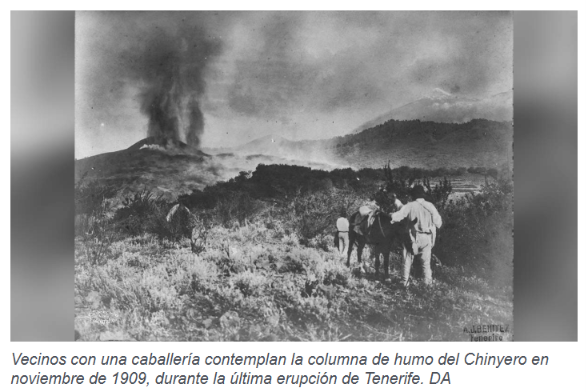
On 18 November 1909, the ground in Tenerife started to shake. José Hernández Lorenzo was working in Los Llanos when he heard a loud noise, like a flock of doves taking off, followed by a metallic rumble. It was the start of the Chinyero eruption.
It went on to become the first major eruption in Spain to be widely covered by the press. It lasted ten days, ended on 27 November 1909, and nobody was killed.
Historian Marcos Brito has pulled the story together in his book Erupción del Chinyero a través de la prensa (The Chinyero eruption through the press), which collects the newspaper reports and photographs from the time.
Were there any warning signs?
Yes. Tremors had been felt since July 1908, and they got stronger in mid-November 1909. Icod town hall even wrote to the civil governor about repeated small tremors, plus one particularly strong one that frightened residents.
Who lived nearby?
Not many people. Around 3,500 lived in Guía de Isora, 1,500 in Santiago del Teide and 1,200 in El Tanque. There was very little infrastructure, and communication relied on things like messenger pigeons and small boats.
What happened on the day?
The first official report described clear signs of volcanic activity on the slopes of Teide. The mayor asked for the telegraph service to stay open as the volcano grew more active, with loud explosions and a column of reddish smoke.
He also warned that people from the nearby Valle de Santiago had fled towards the coast, afraid the lava would reach them.
By the evening there were reports of big explosions, smoke and several eruptive vents. Worry grew as the lava seemed to be heading towards Santiago, and more requests went out for help and transport, including boats to evacuate residents.
How did the news get out?
Quickly, considering the time. Even before anyone was sure exactly where the eruption was, the newspapers were reporting it, and the news reached mainland Spain on 20 November.
Local correspondent Abraham Trujillo Ferrer gave an accurate account of the eruption. He also described how the island suddenly became a gathering point for scientists and journalists.
Volcano tourism, 1909 style
Local shipping companies saw an opportunity and started selling excursions to see the volcano. Some things never change.
The science came later. Lucas Fernández Navarro arrived in Santa Cruz on 4 December and drew up the first scientific map of the eruption.