You’re never too old to learn something new, and a group of older residents in Tenerife have been getting a closer look at the science and technology behind some of the island’s most exciting research.
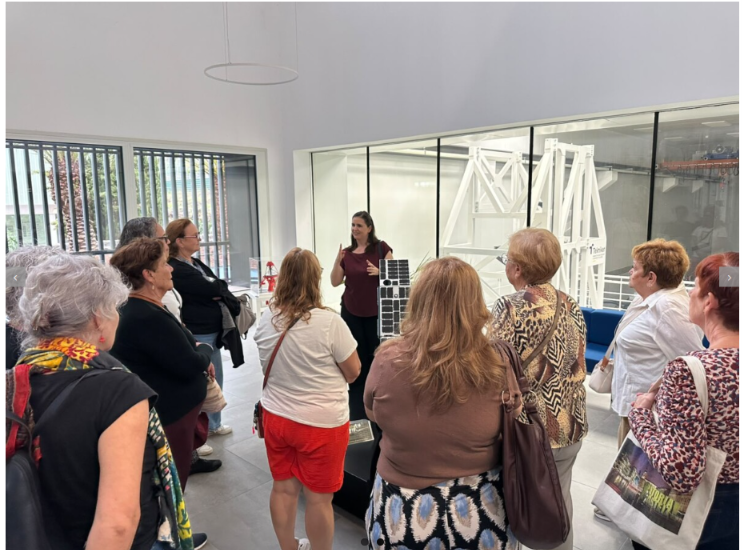
The initiative, called Islénior Tiempo de Estrellas, brought together Islénior, Planeta Ciencia and the Instituto de Astrofísica de Canarias (IAC) for a visit to the IACTEC facilities at the Tenerife Science and Technology Park in Las Mantecas.
Participants came from four older people’s associations: La Candelaria San Román, San Jerónimo, Las Mantecas and Carpe Diem.
The idea was to introduce them to the world of astrophysics and innovation in a way that was accessible, enjoyable and, hopefully, a little different from the usual afternoon activity.
A look behind the scenes at IACTEC
During a guided tour of the IACTEC building, visitors learned about projects covering three main areas: space, medical technology and large telescopes.
The explanations included work on microsatellites, Earth observation equipment and the development of advanced astronomical instruments.
One of the more unusual parts of the visit involved virtual reality headsets, allowing participants to experience a simulated view from the New Robotic Telescope (NRT), which is currently being developed at the same facilities.
Not quite the same as travelling into space, but probably a little easier to arrange.
Learning how astronomers study the universe
The visit also included a practical workshop led by Lucas Pereira, a researcher and science communicator from Planeta Ciencia.
He introduced participants to astrophysical spectroscopy, a technique used to study electromagnetic radiation emitted by celestial objects, including infrared light.
In simple terms, it helps scientists understand what distant objects in space are made of by analysing the light they produce.
Social Action councillor Águeda Fumero praised the collaboration between the organisations involved, saying it gave older residents the opportunity to get closer to innovation, scientific knowledge and Tenerife’s research community.
She also highlighted the importance of ensuring that older people remain active participants in society and continue to have opportunities to learn about subjects such as technology and science.
It’s a good reminder that curiosity doesn’t come with an age limit, and there’s no reason why the latest developments in science should be reserved for the younger generations.