
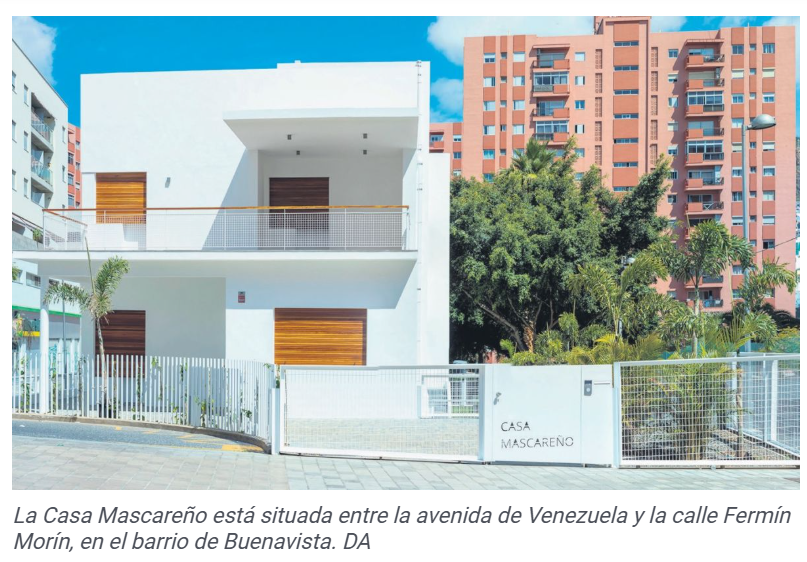
Casa Mascareño is one of those buildings in Santa Cruz that you could easily walk past without realising quite how important it is.
Tucked between Avenida Venezuela and Calle Fermín Morín in the Buenavista area, the house was commissioned by Carmelo Mascareño in 1935 and built in the middle of his banana plantation.
It was designed by architect José Blasco Robles and is regarded as his finest work.
The building is a good example of rationalist architecture, which basically means stripping away the unnecessary stuff and letting the building do its job. No grand classical columns, fancy cornices or decorative flourishes. Just clean lines, practical spaces and a design that makes sense.
Casa Mascareño was declared a Bien de Interés Cultural in 2008, and the international Docomomo organisation, which documents important examples of modern architecture, considers it one of Spain’s significant rationalist buildings.
Designed for Tenerife
The house wasn’t simply designed to look good.
Blasco Robles took the Canary Islands climate into account when planning the building, including the orientation of the rooms and the position of the windows.
It has two floors plus a semi-basement, with reinforced concrete used for the structure, pillars and flat roof. Prefabricated blocks were used for the walls, while the house also featured metal carpentry, folding shutters and different flooring and tiles throughout the rooms.
The main entrance is on the western side, beneath a small porch reached by five steps.
Inside, one of the more interesting features is the relationship between the hall and dining room. They are connected open spaces, with no traditional entrance hall getting in the way.
The terrace sits over the ground-floor slab and has a projecting section supported by metal tie rods.
It is very much a product of its time, but it was also designed with the practicalities of living in Tenerife in mind.
Then things went badly wrong
The story of Casa Mascareño wasn’t always quite so glamorous.
In 1980, the heirs of Carmelo Mascareño sold the estate to Canarias de Edificaciones, S.A. The house subsequently fell into serious disrepair and was eventually used as a storage area for a nearby construction project.
Tools, equipment and all sorts of building materials ended up inside.
Later, the building was occupied by people without a home. An unfortunate fire, caused by a mattress being burned on the second floor, damaged the property further.
The house was also stripped of much of what remained inside, leaving little more than the structural elements.
After repeated complaints from local residents, Santa Cruz City Council eventually boarded up the windows and doors.
Not exactly the future you would expect for one of the island’s important examples of rationalist architecture.
The restoration
Things finally started to change in 2019, when Santa Cruz City Council put the complete rehabilitation of Casa Mascareño out to tender.
The plan was to give the building a new public use as a centre for urban cultural activity aimed at young people in the Salud-La Salle district.
That meant adapting the original building without losing its character.
Some of the rooms had to be enlarged, the main staircase was extended down to the basement and a lift was installed to reach the third floor to meet accessibility requirements.
The gardens around the house were also restored and adapted.
Casa de la Juventud
In 2023, the building opened a new chapter as the Casa de la Juventud, becoming a meeting point for young people in Santa Cruz.
It now includes a youth information point, areas for different activities, multi-purpose spaces for cultural events, exhibitions, performances and screenings, as well as rooms for meetings, talks, conferences and training.
There are also computer rooms, recording facilities and spaces for more informal activities such as board games.
So Casa Mascareño has gone from being a private home surrounded by banana plants, to a neglected building that was at serious risk of disappearing, and finally to a public space being used by a new generation.
Not a bad second act for a house built in 1935.