
Santa Cruz is full of little details that people walk past every day without really noticing.
Old fountains. Busts of long-forgotten figures. Sculptures that have been standing quietly on a corner for decades.
Now the city has decided that some of those pieces aren’t going anywhere.
A new Cultural Heritage Protection Catalogue, recently approved by the Santa Cruz council and currently open for public review, has identified twenty urban elements that will now be fully protected. In simple terms… they’re now pretty much untouchable.
What the new catalogue does
The catalogue, prepared through the municipal urban planning department, protects these pieces because of their historical, artistic and cultural value.
The idea is straightforward.
No future construction work, redesign of public spaces or urban changes should damage or remove them. They’re now officially considered part of the identity and landscape of Santa Cruz.
And some of them will be very familiar.
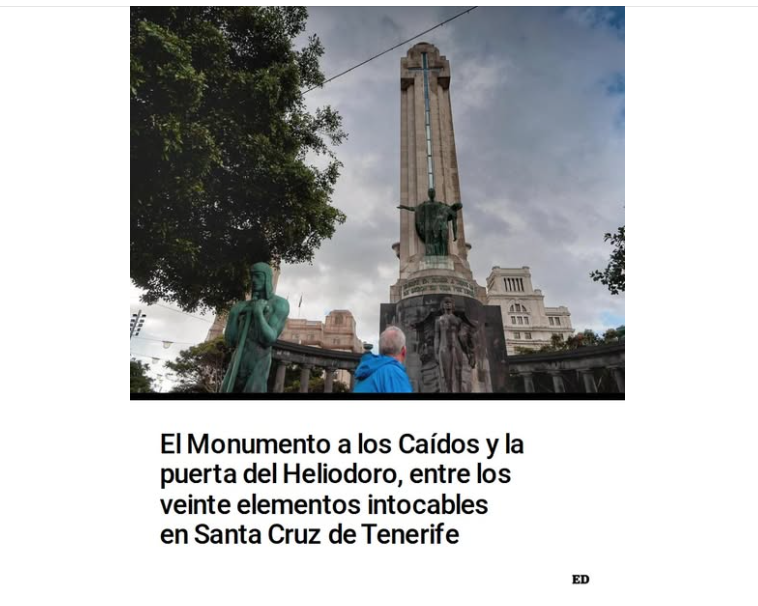
The Monumento a los Caídos
One of the most recognisable structures on the list is the Monumento a los Caídos in Plaza de España.
It was designed by Enrique Cejas Zaldívar and Alonso de Mesa and built following a competition launched in 1944 by General García Escámez.
The monument was intended as a tribute to those who died during what the Franco regime called the “War of National Liberation”.
Architecturally, the catalogue describes it as a monumental example of Franco-era architecture, with influences from Italian fascist design.
Politics aside, the structure has become a defining feature of Plaza de España, which is why the city wants to preserve it.
The original Heliodoro stadium gate
Another interesting addition is the Puerta de Herradura from the Heliodoro Rodríguez López stadium.
If you’ve walked along Avenida San Sebastián, you’ve probably seen it.
It’s actually the only remaining original part of the stadium built in 1950, before the major renovations carried out in the 1990s.
The gate was originally designed as the main entrance to the stadium, complete with sculpted shields, decorative circular windows and classical-style columns.
Today it’s protected because of both its architectural design and its emotional connection with football fans in the city.
Historic fountains
Two historic fountains are also on the protected list.
One is the Fuente de Isabel II, located in Calle La Marina, built in 1844 and designed by Pedro Maffiote.
It’s considered a classic example of 19th-century urban sculpture, and it forms part of the historic setting around Plaza de Isabel II.
The other is the Fuente de la Alameda del Duque de Santa Elena, which dates all the way back to 1787.
Carved in white Carrara marble and brought from Genoa, it was designed as the centrepiece of the Alameda promenade. Many locals know it as the Fuente de los Delfines, thanks to the dolphin figures that originally crowned the fountain.
Busts and monuments
Several busts and monuments have also been included.
Among them are:
- Juan Bautista Antequera y Bobadilla, vice-admiral and naval minister
- José Francisco Morazán, a Honduran political and military leader
- Ireneo González, a respected Canary Islands educator and writer
These pieces recognise historical figures connected to naval history, Latin American ties and local cultural life.
Sculptures across the city
A number of modern sculptures have also been protected, many of which came from the International Street Sculpture Exhibition, which helped turn Santa Cruz into an open-air gallery.
These include works such as:
- Lady Tenerife
- Gran Cabeza Africana
- Siete Islas
- La Mujer de la Estrella
- El Reloj de la Muerte
- Macla
- Femme Bouteille
- Several abstract pieces by artists like Andreu Alfaro, Francisco Sobrino and Eusebio Sempere
They’re scattered around places like Rambla de Santa Cruz, Plaza del Patriotismo, Avenida de Anaga and Parque de Las Indias.
A city museum in plain sight
Santa Cruz has always had an interesting mix of historic monuments and modern sculptures, but many people barely notice them anymore.
This catalogue is basically the city saying…
“These things are part of who we are. They stay.”
And in a place where new developments pop up every year, it’s probably not a bad idea to keep a few reminders of the past firmly in place.
You can read the original article here.